
Monday to Saturday - 9:00 am -18:00 pm

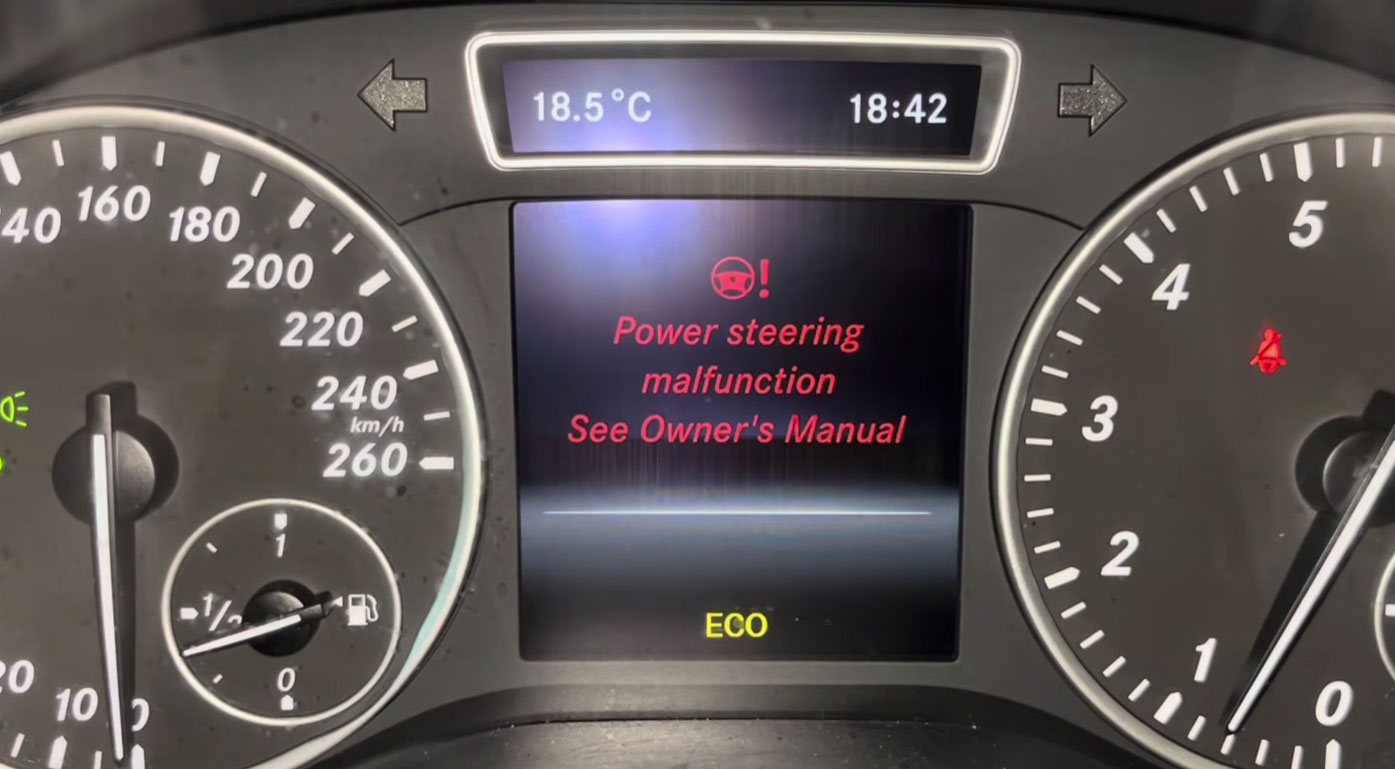
When your Mercedes dashboard suddenly shows “Power Steering Malfunction – See Operator’s Manual,” your heart probably skips a beat. You’re wondering the same thing every driver wonders: Can I still drive this car safely?
The short answer is yes, but with caution. Your steering will feel heavy, especially at low speeds. It’s drivable in most cases, but you need to know what’s happening and when to stop driving immediately.
I’ve worked on hundreds of Mercedes with this exact warning. Most of the time, it’s an electrical issue, not a mechanical problem. But you need to understand which causes are serious and which ones are simple fixes.
This guide will tell you exactly what’s wrong, whether it’s safe to drive, and what to do next
What “Power Steering Malfunction” Actually Means
Your Mercedes uses an electric power steering system. This system uses a small electric motor to help turn your wheels.
When the system detects a problem, it shuts off the power assistance. You can still steer the car, but it will feel like you’re pushing much harder than normal.
Think of it like this: power steering makes turning the wheel effortless. Without it, you’re basically doing the job yourself—and that’s much harder work.
Modern Mercedes use electric power steering, not hydraulic
Older cars had hydraulic systems (with fluid pumps). Modern Mercedes (2010 and newer) rely on electric motors instead.
This is actually a good thing when something goes wrong. Electric systems can be reset or fixed by checking a few electrical connections. Hydraulic systems often need full replacements.
The system detects problems early
Your Mercedes computer is constantly checking the steering system. If it notices something wrong—a loose wire, a weak battery, a faulty sensor—it will shut down power assist to keep you safe.
This is a safety feature, not a failure of the car.
Is It Safe to Drive?
Yes, usually. But there are rules.
You can drive a Mercedes with power steering malfunction if you follow these conditions:
Safe to drive if:
- You’re driving on familiar roads
- You’re in light to moderate traffic
- You’re not on highways or busy streets
- The steering feels responsive (just heavy)
- No other warning lights are on
DO NOT drive if:
- You’re on a highway at speed
- You’re in heavy city traffic
- You’re on winding mountain roads
- The steering feels completely stuck or unresponsive
- Other warnings like ABS or ESP are also lit
- You feel unsafe at all
Why steering feels so different
Without power assist, your Mercedes feels like a truck from the 1970s. Everything requires twice the effort. Your arms will get tired. Parking becomes a workout.
Low-speed maneuvers are the hardest part. At highway speeds, the pressure of the road keeps the wheels straighter, so it feels easier.
Real-world example
I had a customer whose power steering cut out on the highway. She said it was like suddenly switching from an automatic to a manual car—surprising and uncomfortable, but she could handle it.
The problem? She was in the left lane during rush hour. She couldn’t steer quickly enough to change lanes safely. She pulled over and called for a tow.
The lesson: know your limits.
The Real Causes
Here are the actual causes I see in the shop. I’ve ranked them by how common they are.
1. Low or Weak Battery Voltage (MOST COMMON)
This is the #1 reason your power steering shuts down.
Your electric power steering motor needs stable power. If your battery is weak, the system can’t get enough power, so it shuts down.
You’ll notice:
- The warning appears after short drives
- The car is slow to start
- Lights seem dimmer than usual
- The warning sometimes clears after a longer drive
Why this happens:
- Your battery is aging (most batteries last 3-5 years)
- Your alternator isn’t charging properly
- A loose battery cable
- A faulty voltage regulator
Quick test: Start the engine. Does it crank slowly? That’s a battery issue.
2. Blown Fuse (SECOND MOST COMMON)
Your Mercedes has a 100–125 amp fuse in the engine compartment that powers the entire steering system.
If this fuse blows, the steering motor gets no power at all.
You’ll notice:
- The warning appears suddenly
- It doesn’t go away after driving
- The steering is completely heavy
Why this happens:
- The fuse reached the end of its life
- A short circuit in the wiring
- The steering motor itself is drawing too much current
The fix: A new fuse costs $5. But if it blows again immediately, you have a bigger electrical problem.
3. Loose or Corroded Battery Connections
The wires connecting your battery to the car can loosen or corrode over time.
Even though your battery has good voltage, the steering computer can’t access the power because the connection is bad.
You’ll notice:
- The warning appears randomly
- Sometimes steering works, sometimes it doesn’t
- Battery light might flicker too
Quick test: Open the hood and look at the two large wires on your battery. Are they tight? Any white, blue, or greenish powder on the connections? That’s corrosion.
The fix: Clean the connections and tighten them. Costs nothing if you do it yourself.
4. Faulty Steering Angle Sensor
This sensor tells your steering computer where your wheels are pointing.
If the sensor sends wrong information, the computer shuts everything down.
You’ll notice:
- The warning comes and goes
- The steering feels jerky or inconsistent
- You might hear clicks or ticking
Where it’s located: Under the steering column or at the steering rack. It’s hard to access without special tools.
The fix: A technician needs to diagnose this with a scanner. Not a DIY job.
5. Steering Motor Failure
The electric motor that does the actual power steering can wear out.
Modern Mercedes motors last a long time, but they do fail eventually.
You’ll notice:
- The warning is constant (doesn’t go away)
- Steering is consistently heavy
- You might hear a grinding noise when turning
Why this happens:
- Normal wear and tear (high mileage)
- Overheating from hard driving
- An internal electrical short
The fix: The motor needs to be replaced. This is an expensive repair ($800–$1,500).
6. Software or Control Unit Issues
Sometimes the computer controlling the steering system has a glitch.
This is rare, but Mercedes has had recalls for this exact problem.
Real example: Mercedes recalled 28,000 2015 C300 and C400 models because bad software shut down power steering assist at idle. Drivers had to force the wheel during parking.
The fix: A software update from the dealership. Usually free under warranty or recall.
7. CAN Bus Communication Error
Your Mercedes computer networks multiple systems together through something called the CAN bus.
If this communication breaks, the steering computer can’t talk to other systems, so it shuts down as a safety measure.
You’ll notice:
- Multiple warning lights at once (steering, ABS, ESP)
- The warnings come and go together
- They clear when you restart the car
Why this happens:
- Loose ground wires
- Coroded connectors
- Faulty body control modules
The fix: A diagnostic scanner can identify the exact communication error. Usually fixable by a professional.
Quick Fixes You Can Try Right Now
Before you call a mechanic, try these three things:
Reset #1: The Simple Restart (Works 30% of the time)
- Turn off your engine completely
- Remove the key (or turn off ignition for push-button start)
- Wait 3-5 minutes with the engine off
- Do not turn on lights or electronics during this time
- Restart the engine
- Turn the steering wheel slowly from full left to full right 3-4 times
- Take a short test drive
Why this works: The steering computer resets its self-check. Many electrical glitches clear after a full power down.
When it works:
- Battery was weak and needed a recharge
- The computer had a temporary glitch
- A sensor needed to recalibrate
Reset #2: Longer Drive (Works 20% of the time)
- Start the engine
- Drive for at least 1 hour on highway or steady roads
- Keep the car at normal driving temperature
- The battery will charge fully during this time
- The steering computer will run through all its checks
Why this works: If your battery was weak, this gives it time to charge. It also gives the computer time to run diagnostic tests and clear temporary errors.
When it works:
- Your battery was low but not dead
- You had a temporary voltage drop
- The alternator just needed to work and charge
Reset #3: Check and Clean Battery Connections (Works 15% of the time)
- Turn off the engine
- Open the hood
- Locate the battery (usually passenger side in newer Mercedes)
- Look at the large black and red wires connected to it
- Are they tight? Wiggle them gently—they shouldn’t move
- See white, blue, or green crusty powder? That’s corrosion
If connections are loose:
- Turn off all electronics
- Disconnect the negative (black) cable first
- Wait 5 minutes
- Look at the battery post (the metal stud on top of the battery)
- If it’s corroded, clean it with a wire brush and baking soda paste
- Reconnect the black cable tightly
- Then reconnect the red (positive) cable
If it’s just corrosion: Use a paste of baking soda and water. Scrub gently. This costs nothing.
Warning: Do NOT do this
- Do not disconnect the positive cable first (you can create a spark)
- Do not pull hard on the cables
- Do not use high-pressure water on the battery area
- Do not ignore a battery that’s constantly low
When to Stop Driving Immediately
Stop driving your Mercedes right now if any of these are true:
Hard Stop Signs
1. The steering wheel feels completely locked or unmovable
This is not just heavy—it’s stuck. You can’t turn it even with effort.
Action: Pull over immediately and call a tow truck.
2. Power steering comes and goes while driving
You’re at a red light, steering works. You accelerate, it cuts out. This is dangerous.
You can’t predict when it will fail. You might lose power in a critical moment.
Action: Drive slowly to the nearest safe location and stop.
3. Other warning lights are on at the same time
If ABS, ESP, or traction control lights are also on, your car’s safety systems are compromised.
Multiple warnings mean a bigger electrical problem.
Action: Stop driving immediately. You have a system-wide issue.
4. You feel unsafe
Trust your gut. If you’re stressed or worried, you are not driving safely.
Action: Pull over. Call for a tow truck.
5. You’re in heavy traffic or on a highway
The warning just came on and you’re in rush hour. You can’t steer quickly enough to change lanes.
Action: Move to the right lane slowly, exit at the next opportunity, and pull over.
Medium Caution Signs
These aren’t emergencies, but you should get to a mechanic:
- The steering is heavy but responsive
- The warning is consistent (not coming and going)
- Other systems seem to work fine
- You’re familiar with the roads you’re on
What to do:
- Drive slowly and smoothly
- Avoid busy roads or highways
- Don’t try to park in tight spaces
- Get to a mechanic within a day or two
- If the warning clears, you can still drive normally, but get it checked
Professional Repairs and Costs
If your DIY resets don’t work, you need professional help. Here’s what to expect.
Step 1: Professional Diagnostic ($100–$200)
A Mercedes technician will:
- Connect a diagnostic scanner to read all fault codes
- Check your battery voltage and health
- Inspect all visible wires and connections
- Test the alternator
- Review the codes and tell you exactly what’s wrong
What you’ll learn:
- The exact cause of your problem
- Whether it’s electrical or mechanical
- If there’s a recall for your car
- A guaranteed repair cost
Step 2: Common Professional Repairs and Costs
Battery replacement: $150–$300
- Your battery is weak or dead
- Dealership or independent shop
- Takes 30 minutes
Alternator replacement: $400–$700
- Your alternator isn’t charging the battery
- More complex than a battery
- Takes 1-2 hours
Fuse replacement: $25–$75
- A simple fuse blew
- This is quick work
- But if it blows again, there’s a bigger problem
Steering motor replacement: $800–$1,500
- The electric power steering motor failed
- More complex repair
- Requires removing steering rack
- Takes 3-4 hours
Steering rack replacement: $1,500–$3,000
- The entire steering rack assembly needs replacing
- Includes the motor, sensors, and control module
- Takes 4-6 hours
- Requires alignment after
Software update: $0–$500
- The steering control computer has a glitch
- Dealership downloads new software
- Some updates are free under recall
- Takes 1-2 hours
Ground wire repair: $200–$400
- A corroded or loose ground connection
- Often near the engine bay
- Takes 1-2 hours
- Common on older Mercedes
Where to go for repairs
Mercedes dealership:
- Pros: They know your exact car, have OEM parts, might cover recalls
- Cons: Expensive, slower, less personal
- Cost: Usually 20-30% more than independent shops
Independent Mercedes specialist:
- Pros: Often cheaper, faster, more personal
- Cons: Quality varies, might not have latest diagnostic tools
- Cost: Usually 20-30% less than dealership
General mechanic:
- Pros: Cheapest initial diagnostic
- Cons: Might not have Mercedes diagnostic tools, could miss electrical issues
- Risk: Wrong diagnosis could cost you money
My recommendation: Get a diagnostic at an independent Mercedes specialist first. If they can’t figure it out, go to the dealership.
Common Myths About Mercedes Power Steering
Myth #1: Power steering malfunction means your steering is broken
False. Your steering is fine. The electrical power assist is broken.
You can still steer. It will just feel heavy. This is more annoying than dangerous.
Myth #2: You cannot drive at all with this warning
False. You absolutely can drive. Just not on highways at speed or in heavy traffic.
Mercedes wouldn’t design a system that leaves you stranded.
Myth #3: This is always an expensive repair
False. The most common cause is a weak battery ($150–$300).
Even if it’s the steering motor ($1,000), that’s not catastrophic. And many repairs are under $500.
Myth #4: This warning means something mechanical broke
False. 90% of power steering malfunctions are electrical problems.
Bad battery, loose wire, blown fuse, or a software glitch. Not mechanical failure.
The steering rack itself is actually very reliable.
Myth #5: I need to go to a Mercedes dealership immediately
False. You can drive safely to an independent shop first.
Get a diagnostic there. If they can’t help, then go to the dealership.
You don’t need emergency roadside service unless you feel unsafe.
Myth #6: Resetting the car won’t help
False. A simple restart clears the warning 30-40% of the time.
Many drivers don’t even try this before calling a mechanic.
Myth #7: This is a known Mercedes defect
Partially true. A few model years had recalls:
- 2015 C300 and C400 (software issue)
- Some Metris vans (welding defect in the control module)
Check your VIN on the NHTSA website to see if your car is under recall.
Frequently Asked Questions
Q: My power steering warning came on. Can I drive to work?
A: Depends on your commute. If it’s 5 minutes on quiet streets, yes. If it’s 30 minutes on the highway, no.
Test it first on a quiet road. Turn the wheel side to side. Does it feel stiff but responsive? You’re okay for a short, slow drive.
If you feel unsafe, call a tow truck. Your stress is not worth the risk.
Q: I turned the car off and back on. The warning is gone. Am I fixed?
A: Maybe. The warning might come back.
Drive the car for a few days and watch carefully. If it doesn’t return, you had a temporary glitch (usually electrical).
But get a diagnostic check anyway. Something caused that warning. It might happen again.
Q: My battery is old. Could that be the cause?
A: Almost certainly.
If your battery is more than 3-4 years old and your power steering warning just appeared, that’s the problem.
A diagnostic test will confirm it in 10 minutes.
Q: Is it expensive to fix?
A: No. A battery is $150–$300.
If you need more work, here’s the typical cost range:
- Easy electrical fix: $100–$400
- Steering motor: $800–$1,500
- Steering rack: $1,500–$3,000
Even the expensive repairs aren’t catastrophic for a luxury car.
Q: My Mercedes had this warning, I ignored it, and it went away. Is it gone for good?
A: No.
It might come back at any time. You got lucky.
Get a diagnostic now while the car is working. Find out what caused it. Fix it before it becomes a real emergency.
Ignoring it is gambling.
Q: My ABS and ESP lights are on too. Is this related?
A: Very likely.
These systems share electrical connections and data through the CAN bus.
One electrical problem can trigger multiple warnings. This needs a professional diagnostic with a full system scanner.
Do not ignore this. Get to a mechanic.
Q: Do I need to go to a Mercedes dealership?
A: No.
A good independent Mercedes specialist can diagnose and fix this faster and cheaper.
Only go to the dealership if:
- An independent shop can’t figure it out
- Your car is under warranty
- There’s a recall to process
- You prefer the dealership’s warranty on work
Q: Can I fix this myself?
A: Maybe.
If you’re handy and the problem is a loose battery cable or corroded connection, you can clean it yourself.
If you need to replace the steering motor or diagnose a CAN bus error, no. This requires special tools and training.
Don’t guess and throw parts at it. Get a diagnostic first.
Q: How long does it take to fix?
A: Depends on the cause.
- Simple reset: immediate
- Battery replacement: 30 minutes
- Electrical connection: 1-2 hours
- Steering motor: 3-4 hours
- Steering rack: 4-6 hours
A diagnostic takes 30 minutes to an hour.
What to Do Right Now
- Try the three quick fixes (restart, long drive, check battery connections)
- If the warning returns, get a diagnostic ($100–$200)
- Don’t ignore it—it won’t fix itself
- Drive carefully until it’s fixed
- Check for recalls using your VIN at NHTSA.gov
Your Mercedes is telling you something is wrong. It’s doing its job to keep you safe.
The good news? This is almost never a catastrophic repair. It’s almost never a stranded-on-the-side-of-the-road emergency.
But it does need attention. Get it diagnosed, fix it, and move on.
Your power steering will work beautifully again.