
Monday to Saturday - 9:00 am -18:00 pm


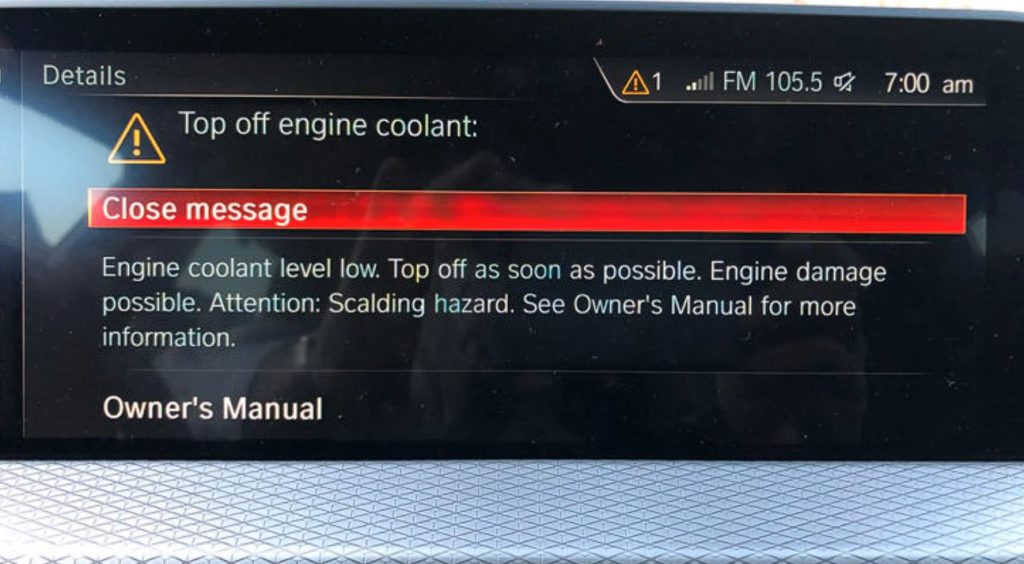
What Does the “Coolant Level Low” Warning Mean in Your BMW?
Your BMW’s dashboard just lit up with a “Coolant Level Low” message. This warning tells you that the engine cooling system doesn’t have enough coolant fluid.
The coolant keeps your engine from overheating. When levels drop too low, your engine is at risk.
From my years working on BMWs, I’ve seen this warning pop up for many reasons. Some are simple fixes. Others need quick attention to avoid expensive damage.
Let’s break down what’s happening under your hood.
Why Is This Warning Important?
Your BMW’s engine runs hot. Very hot. The coolant system keeps temperatures safe.
In my shop, I’ve seen engines seize up from ignoring this warning. That means thousands of dollars in repairs.
Here’s what happens without enough coolant:
- Engine temperature spikes quickly
- Metal parts expand and warp
- Gaskets fail under extreme heat
- Complete engine failure becomes possible
Don’t ignore this light. Even a quick drive can cause permanent damage.
Common Causes of Low Coolant in BMW Vehicles
1. Coolant Leaks (Most Common)
When I service BMWs, coolant leaks are the number one culprit. I see them almost daily.
Where leaks typically occur:
- Radiator hoses develop cracks over time
- Water pump seals wear out and drip
- Radiator tanks split at the plastic seams
- Expansion tank cracks from heat cycles
- Heater core leaks inside the cabin
How to spot a leak:
Look under your car after it sits overnight. Green, orange, or pink puddles mean coolant is escaping.
Check your driveway or parking spot. Fresh coolant has a sweet smell and slick feel.
Pop the hood and inspect hoses. Squeeze them gently. Mushy or cracked hoses need replacement.
2. Faulty Expansion Tank
BMW expansion tanks fail often. The plastic gets brittle with age.
From years under the hood, I replace these tanks regularly on BMWs over 60,000 miles.
Signs your expansion tank is failing:
- Visible cracks in the plastic
- White residue around the cap
- Coolant smell when engine is hot
- Tank looks swollen or deformed
The expansion tank has a pressure cap. This cap must hold 14-16 PSI. A weak cap lets coolant evaporate quickly.
3. Blown Head Gasket
This is serious. A blown head gasket lets coolant leak into the engine cylinders.
Warning signs I look for:
- White smoke from the exhaust pipe
- Milky oil on the dipstick
- Engine overheats frequently
- Coolant disappears with no visible leak
Head gasket repairs cost $1,500 to $3,000. Catch it early to avoid worse damage.
4. Defective Coolant Level Sensor
Sometimes the sensor itself fails. Your coolant level is actually fine.
In my experience, newer BMW models (2010 and up) have sensor issues after 80,000 miles.
The sensor sits in the expansion tank. It reads the coolant level and sends data to your computer.
A bad sensor triggers false warnings. This is frustrating but easy to fix.
5. Thermostat Housing Leaks
BMW thermostat housings are made of plastic. They crack and leak coolant.
I’ve replaced hundreds of these. They typically fail between 70,000 and 100,000 miles.
Look for coolant pooling near the front of the engine. That’s usually the thermostat housing.
6. Water Pump Failure
The water pump circulates coolant through your engine. BMW water pumps are electric on newer models.
Signs of water pump problems:
- Coolant leaks from the pump area
- Grinding or whining noises
- Engine runs hotter than normal
- Warning light for coolant pump failure
Replace the water pump every 80,000 miles as preventive maintenance.
How to Check Your BMW Coolant Level (Step by Step)
Safety first: Never open the cooling system when the engine is hot. You can get serious burns.
Let your car cool for at least 30 minutes after driving.
Step 1: Locate the Expansion Tank
Open your hood. Look for a translucent plastic tank near the firewall.
It has “MIN” and “MAX” lines marked on the side.
Step 2: Check the Level
Look at the coolant level when the engine is cold.
The coolant should sit between MIN and MAX marks.
If it’s below MIN, you need to add coolant.
Step 3: Inspect for Contamination
Good coolant looks clean. Pink, green, or orange depending on type.
Warning signs from my diagnostic experience:
- Rusty brown color means corrosion
- Oily film on top means oil contamination
- Thick sludge means the coolant is old
Contaminated coolant needs a full system flush.
Step 4: Check the Cap
Remove the expansion tank cap slowly. Listen for a hiss.
A strong hiss means the system holds pressure (good sign).
No hiss might mean a pressure problem.
Inspect the cap gasket. It should be soft and intact.
Quick Fix: Adding Coolant to Your BMW
Tools you’ll need:
- Correct BMW coolant (never use universal coolant)
- Distilled water
- Funnel
- Shop towels
The proper coolant mix is 50/50. Half coolant, half distilled water.
In my shop, I use a coolant refractometer to check the mixture. This tool costs about $20 and ensures proper protection.
Adding coolant (with engine cold):
- Remove the expansion tank cap
- Pour slowly until level reaches MAX line
- Don’t overfill past MAX
- Replace cap tightly
- Start engine and let it warm up
- Check level again after 10 minutes
Important: Run the engine with the cap off for a few minutes. This burps air from the system.
Air pockets cause overheating problems.
Which Coolant Should You Use in Your BMW?
Never use generic green coolant in your BMW. I’ve seen this mistake ruin cooling systems.
BMW coolant is different. It’s designed for aluminum engines.
Recommended BMW coolant types:
- BMW Blue Coolant (original formulation)
- BMW Grey Coolant (newer specification)
- Zerex G-48 (approved alternative)
- Pentosin Pentofrost A3
Check your owner’s manual for the exact specification.
From my parts ordering experience, OEM BMW coolant costs $25-35 per gallon. Approved alternatives cost $15-20.
Mixing different coolant types causes chemical reactions. This creates sludge that clogs your system.
Professional Diagnosis: When to Visit a Mechanic
You should get professional help if:
- Warning light returns after adding coolant
- Coolant level drops quickly (within days)
- Engine temperature gauge reads hot
- You see steam from under the hood
- Car runs rough or loses power
- You smell sweet coolant inside the cabin
In my diagnostic routine, I use these tools:
- Cooling system pressure tester ($50 tool)
- UV dye to find hidden leaks
- Infrared thermometer to check temperatures
- Scan tool to read sensor data
A pressure test reveals leaks that aren’t visible. I pressurize the system to 16 PSI and watch for pressure drop.
UV dye shows up under a black light. This finds tiny leaks you can’t see otherwise.
Common BMW Models with Coolant Issues
From my service records, these BMW models have frequent coolant problems:
BMW E90 3-Series (2006-2011)
- Expansion tank cracks often
- Water pump fails around 80,000 miles
- Thermostat housing leaks common
BMW E60 5-Series (2004-2010)
- Coolant sensor failures frequent
- Radiator end tanks crack
- Hose connections leak
BMW F30 3-Series (2012-2019)
- Electric water pump issues
- Sensor malfunctions common
- Expansion tank caps fail
BMW X3 and X5 SUVs
- Higher coolant capacity means bigger leaks
- Difficult access to components
- More expensive repairs due to labor
Preventive Maintenance Tips
Here’s what I tell my customers:
Change coolant every 4 years or 50,000 miles. Old coolant loses its protective properties.
Inspect hoses annually. Squeeze them. Replace if they feel soft or show cracks.
Replace the expansion tank every 60,000-80,000 miles. Don’t wait for it to fail.
Use only BMW-approved coolant. The $10 you save isn’t worth the risk.
Check coolant level monthly. Make it part of your routine maintenance.
Install a new thermostat with the water pump. They often fail together.
When I work on BMWs over 100,000 miles, I recommend replacing the entire cooling system. This includes:
- Radiator
- Hoses (all of them)
- Thermostat housing
- Expansion tank and cap
- Water pump
This costs $1,200-1,800 but prevents roadside breakdowns.
Cost Breakdown for Common Repairs
Based on my shop rates and parts pricing:
Coolant top-off: $0-25 (DIY) or $50-75 (shop)
Expansion tank replacement: $150-300 (tank fails most often)
Radiator hose replacement: $100-200 per hose
Water pump replacement: $600-1,200 (varies by model)
Thermostat housing: $300-500
Radiator replacement: $400-800
Head gasket repair: $1,500-3,000 (worst case scenario)
Complete cooling system overhaul: $1,200-2,000
Labor rates vary by location. These are average estimates for independent BMW specialists.
Dealer prices run 30-50% higher.
Can You Drive with the Coolant Warning On?
No. Stop driving immediately.
I’ve towed too many BMWs that tried to “make it home.” The damage isn’t worth it.
If the warning appears while driving:
- Pull over safely as soon as possible
- Turn off the engine
- Wait 30 minutes for cooling
- Check coolant level (if you can)
- Call for a tow if level is low
A few miles of overheating can warp the cylinder head. This turns a $100 repair into a $3,000 nightmare.
Understanding Your BMW Cooling System
Let me explain how the system works:
The water pump pushes coolant through the engine block. Hot coolant flows to the radiator.
Air passing through the radiator cools the fluid. The thermostat controls coolant flow based on temperature.
The expansion tank handles pressure changes. Coolant expands when hot and contracts when cold.
The whole system is sealed and pressurized. Pressure raises the boiling point of coolant to about 265°F.
Your BMW has sensors monitoring:
- Coolant temperature
- Coolant level
- Water pump operation
- Thermostat position
When something goes wrong, warning lights alert you.
DIY vs Professional Repair: What You Should Know
Simple tasks you can handle:
- Adding coolant
- Checking coolant level
- Replacing expansion tank cap
- Visual leak inspection
Jobs that need a mechanic:
- Pressure testing the system
- Bleeding air from the system properly
- Water pump replacement
- Head gasket repairs
- Radiator replacement
From my teaching experience, most car owners can add coolant safely. But diagnosis requires proper tools and knowledge.
Don’t guess at repairs. A wrong diagnosis wastes money and time.
Final Thoughts from a BMW Mechanic
The “Coolant Level Low” warning isn’t something to ignore. Your BMW’s engine depends on proper cooling.
In my 15+ years working on German cars, I’ve seen what happens when people delay repairs. Small leaks become big problems.
Check your coolant regularly. Use the right fluid. Address leaks quickly.
Your BMW will reward you with reliable performance and long engine life.
If you’re unsure about anything, ask a qualified BMW specialist. We’d rather answer questions than rebuild engines.
Keep your coolant topped off. Keep your BMW running strong.
Drive safe and stay cool!
This article is for informational purposes. Always consult your BMW owner’s manual and a certified mechanic for specific guidance on your vehicle.