
Monday to Saturday - 9:00 am -18:00 pm

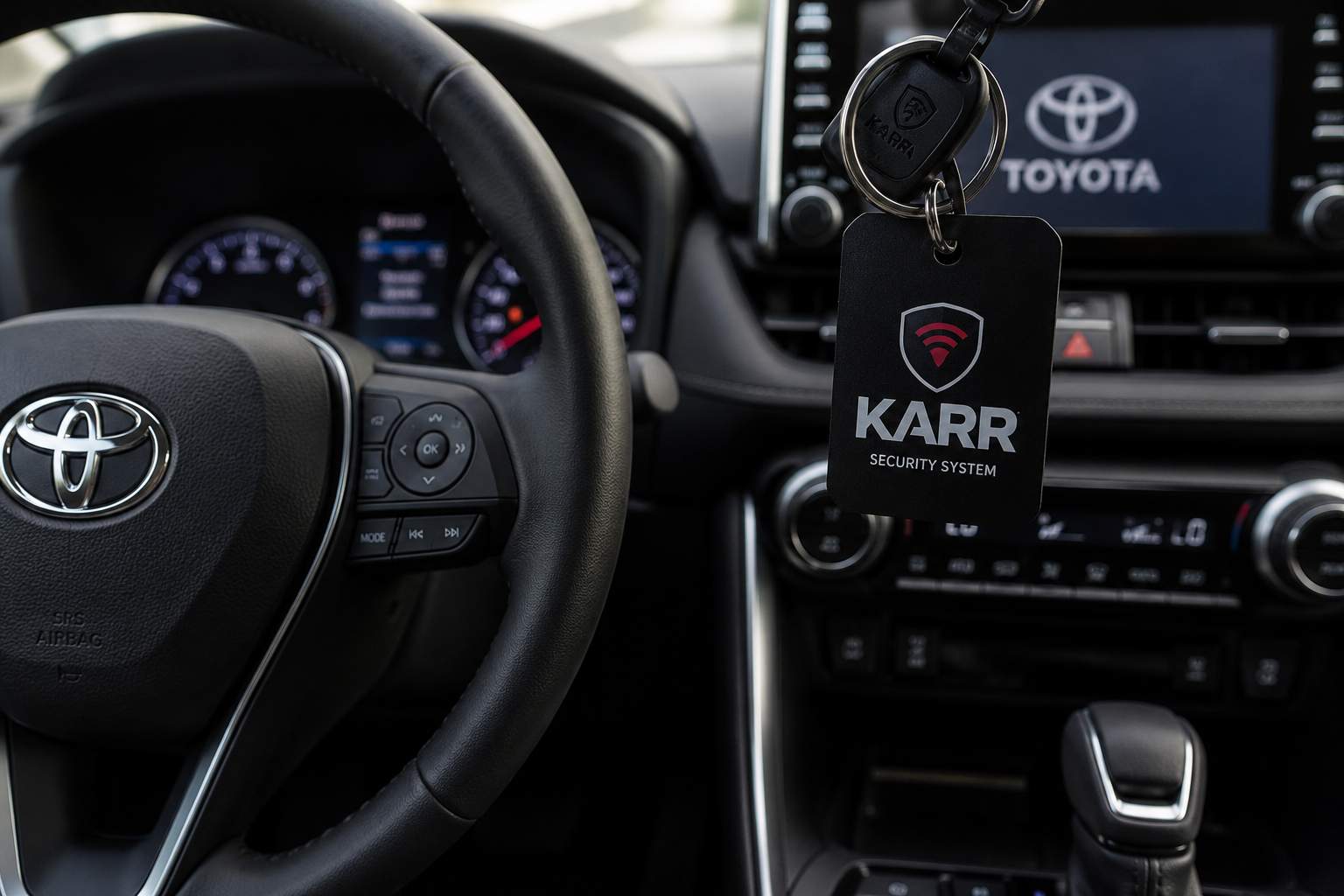
If you just bought a Toyota and found a strange button or blinking light under the dash, you might have a KARR security system. This aftermarket alarm is not made by Toyota. Dealers install it on new cars before selling them.
Many Toyota owners are confused about what KARR does. Some feel tricked into paying for it. Others worry it will cause problems with their car.
In this guide, I’ll explain exactly what a KARR security system is. You’ll learn how it works, why dealers push it, what problems it can cause, and whether you should keep it or remove it.
What Is a KARR Security System?
KARR is an aftermarket car alarm and security system. The name stands for nothing special. It’s just a brand name.
KARR systems are made for dealerships, not for regular customers. You can’t walk into a store and buy one. Dealers install them on cars sitting on their lots.
The system usually includes:
- A shock sensor that triggers an alarm if someone bumps or hits the car
- A starter interrupt that can prevent the car from starting
- A small LED light that blinks to show the system is active
- A valet button hidden under the dash
- Sometimes GPS tracking features
KARR is especially common at Toyota, Honda, and other Japanese brand dealerships. It’s most often seen at dealers in California and other West Coast states. But it shows up all over the US.
Here’s the key thing to understand: KARR is not a Toyota product. Toyota did not design it or approve it as standard equipment. The dealer adds it after the car arrives from the factory.
How Does a KARR System Work?
The KARR system connects to your car’s electrical wiring. A technician must cut and splice into several wires to install it. This is called “tapping into” the wiring harness.
The main parts of a KARR system include:
The Brain Box
This is a small black module about the size of a wallet. It’s usually zip-tied under the dash near the steering column. The brain controls all the alarm functions.
Shock Sensor
This detects impacts to the car. If someone hits your window or bumps the door, the alarm goes off.
Starter Interrupt
This cuts the starter wire so the car won’t start. When the alarm is armed and triggered, the engine won’t turn over. This is supposed to stop thieves from driving away.
LED Indicator
A small blinking light shows the system is armed. This is usually mounted on the dash or near the door.
Valet Button
A small button screwed into the lower dash panel. You press and hold this button to put the system in valet mode. Some KARR systems use this button for programming new remotes too.
Remote Fob
Some KARR systems come with their own remote. The most common model is the KARR 2040a. It has a simple 3-button design. Many systems also work with the factory Toyota key fob.
When you lock your Toyota with the fob, the KARR system can arm automatically. If someone tries to break in, the horn honks and the starter is disabled.
Why Do Toyota Dealers Install KARR?
There are two main reasons dealers install KARR systems. One benefits them. One supposedly benefits you.
Reason 1: Lot Security
New cars sitting on dealer lots are targets for theft. Dealers can arm all KARR-equipped vehicles at once. This lets them immobilize every car on the lot with one remote.
Banks that finance dealer inventory sometimes offer better interest rates if the cars have tracking devices. KARR helps dealers qualify for these lower rates.
Reason 2: Extra Profit
This is the real reason. KARR systems cost dealers very little. Reports suggest the actual cost is under $50 to $200 per unit. But dealers charge customers anywhere from $300 to $1,500.
Many dealers install KARR on every new vehicle. Then they present it as a required add-on when you’re signing papers. Some claim you must pay for it. Others say it’s already installed and can’t be removed.
This practice is known as “dealer add-on” or “dealer-installed accessory.” It’s a way to add profit without raising the sticker price.
The finance manager often brings up KARR right before you sign. You’ve already agreed on a price. You’re excited. They count on you saying yes just to finish the deal.
How Much Does KARR Cost?
The price varies wildly depending on the dealer and how hard they push.
Typical KARR prices at Toyota dealerships:
- Low end: $300-$400
- Mid range: $500-$700
- High end: $800-$1,500
Some dealers bundle KARR with other add-ons like window tint, paint protection, or wheel locks. These packages can hit $2,000 to $4,000.
The actual value of a KARR system is much lower. You can buy better aftermarket alarms with more features for $150 to $250 installed.
Many owners who paid $700 or more for KARR feel they overpaid. The system does work. But it’s a basic alarm that duplicates security features already built into most Toyotas.
KARR vs Toyota Factory Security
Here’s something important: most modern Toyotas already have security features built in.
Toyota Factory Security Includes:
- Engine immobilizer (since the late 1990s)
- Keyless entry with panic button
- Alarm system on many trim levels
- Toyota Connected Services on newer models (GPS tracking, remote lock/unlock)
The engine immobilizer alone stops most theft attempts. Without the correct key chip, the car simply won’t start. This is built into the ignition system from the factory.
Higher trim levels often include a factory alarm. It triggers if someone opens the door without using the key fob. The horn honks and lights flash.
What KARR Adds:
- Shock sensor (detects impacts)
- Possible GPS tracking (on some models)
- Starter interrupt (redundant with immobilizer)
The honest truth? KARR adds very little security beyond what your Toyota already has. The shock sensor is nice to have. But it’s not worth $700.
Toyota also makes their own accessory alarm called the Toyota VIP system. It integrates cleanly with factory wiring and uses the stock key fob. If you really want more security, this is a better choice than KARR.
Common Problems With KARR Systems
This is where things get serious. Many Toyota owners report problems after KARR installation.
Battery Drain
A poorly installed KARR system can slowly drain your battery. The alarm stays active even when parked. If the wiring is bad, it draws more power than it should. You might wake up to a dead battery.
Electrical Glitches
KARR requires cutting and splicing factory wires. Toyota service manuals warn against tampering with OEM wiring. Yet dealers routinely do exactly that.
Problems reported by Toyota owners include:
- Multimedia screens going blank or glitching
- Dashboard warning lights coming on
- Horn sounding weak or different
- Remote start not working correctly
- Smart key issues
- Random alarm triggers
One RAV4 owner reported their multimedia system, horn, and dashboard all malfunctioned. After removing the KARR system, the multimedia and horn worked perfectly again. The dashboard had been damaged by the installation.
No-Start Conditions
The starter interrupt feature can fail. When it does, your car won’t start. You’re stranded until someone can bypass or disable the KARR system.
This is especially frustrating because the alarm might not even be triggered. The KARR module just stops working and locks out the starter.
Botched Installations
Many KARR installations are done quickly by dealer techs who rush through the job. Forum posts describe finding:
- T-tap connectors instead of proper splices
- Drywall screws holding wires instead of proper fasteners
- Loose connections that cause intermittent problems
- Holes drilled crooked in dash panels
- Screws left loose on floor mats
One mechanic who removes KARR systems for customers called them “the absolute cheapest device” with “shit tier installs done by a dealer flunkie.”
Interference With Diagnostics
When something goes wrong with your Toyota, the KARR system can confuse mechanics. They might replace starters, batteries, or fuel pumps when the real problem is a failed alarm module.
Should You Keep or Remove Your KARR System?
This depends on your situation.
Consider Keeping KARR If:
- The system is working without problems
- You live in a high-theft area
- You actually want the shock sensor feature
- Removing it might cause more wiring damage
Consider Removing KARR If:
- You’re having electrical problems
- The alarm triggers randomly
- Your battery keeps dying
- You don’t trust the installation quality
- You want your wiring returned to factory condition
Many mechanics advise: if it’s not causing problems, leave it alone. Removing a poorly installed KARR can sometimes create new issues if the wires aren’t reconnected properly.
But if you’re having trouble, getting rid of KARR often fixes the problem completely.
How to Disable or Remove a KARR Alarm
There are three options: disable, deactivate, or fully remove.
Option 1: Put It in Valet Mode
This temporarily disables the alarm. Find the LED light pod under your dash. When the alarm is disarmed (light not blinking), press and hold the button on the back of the light until it turns solid. The system is now in valet mode and won’t arm.
Option 2: Have KARR Deactivate It
Contact KARR customer service. They can send a technician to deactivate the system for free in many cases. They insert a chip that permanently disables the alarm. The wiring stays in place, but the system does nothing.
This is what happens when you decline to pay for KARR at the dealer. They “deactivate” it but leave everything installed.
Option 3: Full Removal
This requires disconnecting and removing all KARR components. It’s more involved:
- Disconnect the car battery
- Locate the KARR brain box (usually under the dash, driver’s side)
- Trace the wires to find where they tap into factory harnesses
- Remove T-taps or cut the KARR wires at the splice points
- Reconnect any wires that were interrupted (especially the starter wire)
- Tape off any exposed wire ends
- Remove the brain box, LED, and valet button
Warning: If KARR has a starter interrupt, you must reconnect that wire properly. Otherwise your car won’t start.
If you’re not comfortable with electrical work, have a professional do it. Many independent auto electrical shops charge $75 to $150 for KARR removal. Some KARR technicians will remove it for free if you call their customer service line.
Can You Refuse a KARR System When Buying a Toyota?
Yes. You have rights.
Before Purchase:
Tell the salesperson upfront: “I do not want any dealer-installed accessories, including alarm systems.” Put this in writing if possible.
If they say the car already has KARR installed, you can:
- Ask them to remove it completely before delivery
- Refuse to pay for it and have them deactivate it
- Walk away and buy from a different dealer
At Signing:
The finance office is where they push KARR hardest. Stay firm. You don’t have to buy anything you didn’t agree to during price negotiations.
If they claim KARR is “required,” ask to see the state or federal regulation that mandates it. There isn’t one. This is a sales tactic.
The Magnuson-Moss Warranty Act
Some dealers claim adding your own security system will void your Toyota warranty. This is usually false. The Magnuson-Moss Warranty Act protects your right to install aftermarket parts. The dealer must prove the part caused a failure to deny warranty coverage.
Don’t let them scare you into buying KARR with warranty threats.
After Purchase:
If KARR was added without your knowledge or consent, contact the dealer and demand a refund. Many owners have successfully gotten their money back by pushing firmly.
Leave honest reviews on Google, Yelp, and other sites. Dealers watch their ratings closely. The threat of a bad review can motivate them to make things right.
Common Mistakes Toyota Owners Make With KARR
Mistake 1: Paying Full Price Without Negotiating
KARR is pure profit for dealers. They have room to negotiate. Many owners have gotten the price dropped from $800 to $0 just by refusing to pay.
Mistake 2: Assuming KARR Is Required
It’s not. No law requires aftermarket alarms. If a dealer insists, they’re lying or misinformed.
Mistake 3: Thinking KARR Is a Toyota Product
It’s not. Toyota doesn’t make KARR. Toyota doesn’t install KARR. The dealer adds it independently.
Mistake 4: Ignoring Warning Signs
If your Toyota has electrical quirks—random alarms, battery drain, no-start conditions—remember the KARR system. Tell your mechanic about it. Many problems get misdiagnosed because the tech doesn’t know KARR is there.
Mistake 5: DIY Removal Without Understanding the Wiring
If you cut wires without knowing which one is the starter interrupt, your car won’t start. Either learn the system first or pay a professional.
Mistake 6: Leaving KARR Active on Older Vehicles
As cars age, so do alarm systems. A 10-year-old KARR module is more likely to fail and cause problems. Consider removal or deactivation on older Toyotas.
Frequently Asked Questions
Is a KARR security system the same as a Toyota factory alarm?
No. KARR is an aftermarket alarm installed by dealerships. Toyota factory alarms are built into the car at the manufacturing plant. They’re completely separate systems.
Does KARR void my Toyota warranty?
Not by itself. However, if a KARR installation damages your car’s electrical system, that damage might not be covered under warranty. The alarm system itself isn’t covered since it’s not a Toyota part.
Can I program a new KARR remote myself?
Yes, for most models. The KARR 2040a is the most common system. Programming involves pressing the valet button a certain number of times with the ignition on. Instructions vary by model. Search for your specific KARR model number online.
How do I know if my Toyota has a KARR system?
Look for:
- A small blinking LED light on the dash or near the door
- A black button screwed into the lower dash panel
- A black module zip-tied under the steering column
- A KARR sticker on the window or door jamb
Will removing KARR cause electrical problems?
If done correctly, no. The key is reconnecting any wires that were cut, especially the starter wire. Many owners remove KARR without issues. Poor removal can cause problems, just like poor installation.
Why do dealers say KARR protects against warranty issues?
This is a sales tactic. They want you to believe you need KARR for warranty coverage. You don’t. Standard Toyota warranties cover manufacturing defects regardless of whether you have an aftermarket alarm.
Can I get a refund if I didn’t want KARR?
Possibly. If KARR was added without your clear consent, contact the dealer and demand a refund. Be firm but polite. Mention you’ll leave reviews detailing your experience. Many dealers will refund to avoid negative publicity.
Does KARR have GPS tracking?
Some KARR systems include GPS tracking. Others don’t. The basic alarm models like the 2040a do not have GPS. Higher-end KARR systems with tracking require a subscription service.
Final Thoughts
A KARR security system on your Toyota is a dealer-installed aftermarket alarm. It’s not made by Toyota. It’s not required. And it’s often overpriced.
The system does work. It adds a shock sensor and starter interrupt to your car. But most modern Toyotas already have good built-in security. KARR duplicates features you probably already have.
The real concern is installation quality. KARR requires cutting into your Toyota’s factory wiring. Bad installations cause battery drain, electrical glitches, and no-start problems.
If you’re buying a new Toyota, refuse KARR upfront. If you already have one and it’s working fine, you can leave it. But if you’re having electrical issues, KARR might be the culprit. Removal often solves the problem.
Don’t let a dealer pressure you into paying $700 for a $50 alarm. Know your rights. And if something feels off with your car’s electronics, remember to check under that dash.
Your Toyota was designed to work perfectly without KARR. Sometimes the best security system is the one Toyota already built in.