
Monday to Saturday - 9:00 am -18:00 pm

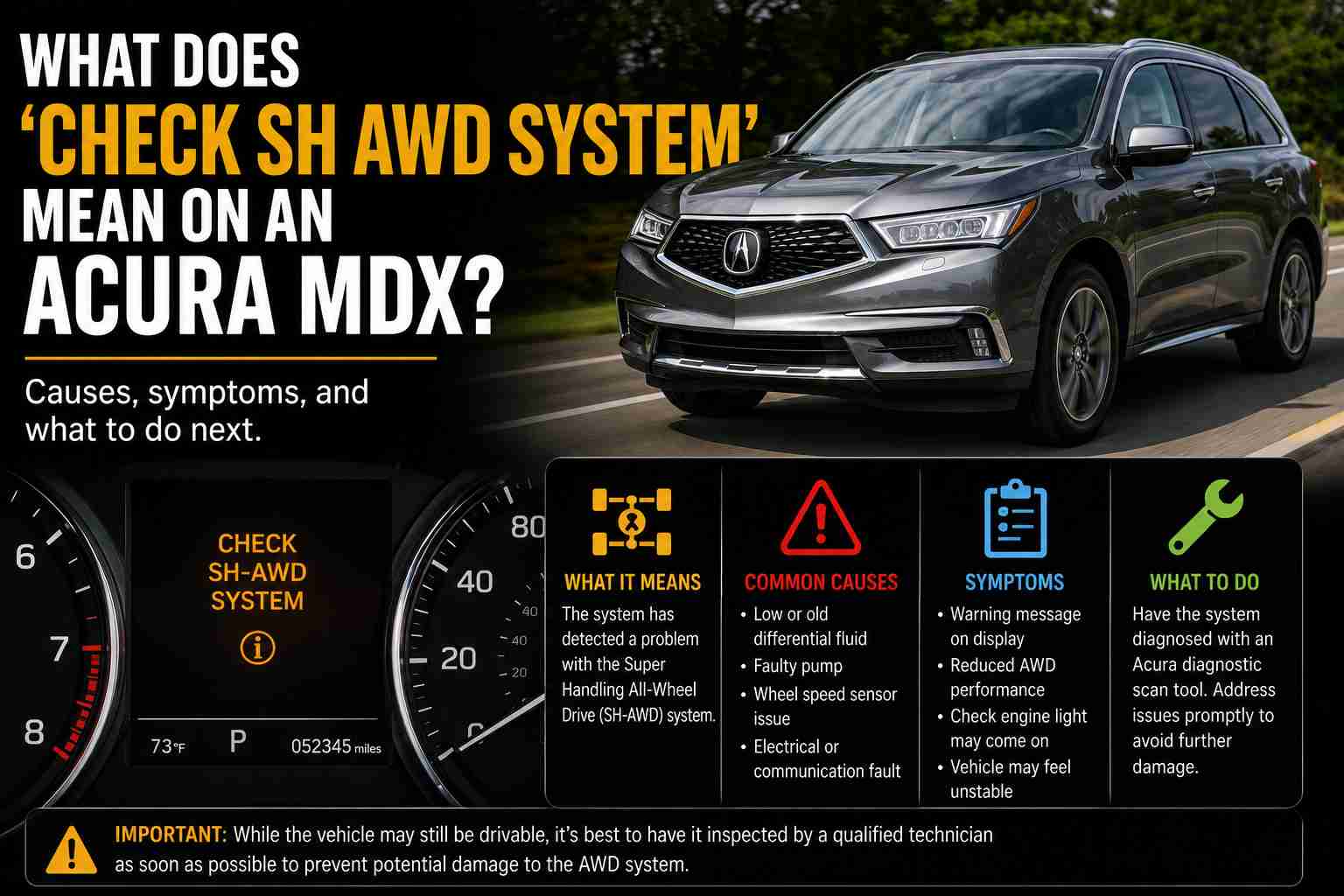
Seeing “Check SH AWD System” pop up on your Acura MDX dashboard can make your heart skip a beat. You’re probably wondering if it’s safe to keep driving. And you’re worried about a big repair bill.
Here’s the short answer: This warning means your all-wheel-drive system has detected a problem. Your MDX has likely switched to front-wheel drive only. You can usually keep driving short distances, but you need to get it checked soon.
In this guide, I’ll explain exactly what causes this warning. I’ll show you common fixes—some you can do yourself. And I’ll tell you when you need a mechanic.
What Is the SH-AWD System?
SH-AWD stands for Super Handling All-Wheel Drive. It’s Acura’s advanced AWD technology.
Regular AWD systems just send power to wheels that need traction. SH-AWD does much more than that.
This system constantly monitors your driving. It adjusts power to each wheel in real time. It can send up to 70% of engine power to the rear wheels. It can also shift power side to side between the rear wheels.
This gives you better grip on slippery roads. It also helps the MDX handle better on dry pavement. The system makes the MDX feel more agile in corners.
The SH-AWD system uses several key parts. There’s a rear differential that splits power between the rear wheels. Multiple sensors track wheel speed, steering angle, and throttle position. A control module processes all this data and makes adjustments.
When any of these parts have problems, you’ll see the Check SH AWD System warning.
What Happens When This Warning Comes On?
When the warning appears, your MDX goes into a “fail-safe” mode.
The vehicle switches to front-wheel drive only. The rear wheels won’t receive any power. You lose the benefits of all-wheel drive.
You’ll likely notice some changes in how the car drives. There may be more wheel spin when accelerating. The car might feel less stable in turns. On slippery roads, you’ll have less traction than before.
The system does this to protect itself from further damage. Think of it like a limp mode for the AWD system.
On your dashboard, you’ll see the message on your main display. Some models also show an orange or yellow indicator light. You might see “SH-AWD” with a warning symbol.
If you check the torque distribution display on your dashboard, you’ll notice the rear wheels show zero power.
Common Causes of the SH-AWD Warning
I’ve seen many MDX owners deal with this warning. Here are the most common causes, starting with the easiest to fix.
1. Check Engine Light Triggered It
Here’s something most people don’t know. An engine problem can trigger the SH-AWD warning.
When your check engine light comes on, the MDX often disables the AWD system. It’s a safety feature. The car’s computer thinks something might be wrong, so it plays it safe.
Common engine issues that cause this include faulty oxygen sensors, a loose gas cap, dirty EGR valves, and misfiring spark plugs.
Fixing the engine problem often makes the SH-AWD warning go away too.
2. Low or Dirty Differential Fluid
The rear differential needs special fluid to work properly. Acura calls it DPSF (Dual Pump System Fluid) on newer models.
If this fluid gets low or dirty, the SH-AWD system can’t work right. You might hear grinding noises or feel vibrations from the rear of the car.
Acura recommends changing this fluid every 15,000 to 30,000 miles. Many owners skip this and pay for it later.
3. Wheel Speed Sensor Problems
Your MDX has wheel speed sensors at each wheel. They tell the computer how fast each wheel is spinning.
If a sensor fails or gets dirty, it sends bad data. The computer sees wheels spinning at different speeds and thinks something is wrong.
Sensor problems are often caused by dirt and debris buildup, damaged wiring, corroded connectors, and worn wheel bearings that affect the sensor.
A failing wheel speed sensor might also trigger your ABS and VSA warning lights.
4. Tire Size Mismatch
All four tires must be the same size. Even small differences can confuse the SH-AWD system.
If you replace one or two tires with a different size, the sensors will detect a mismatch. The system thinks the wheels are spinning at different rates.
This is why you should always replace tires in sets of four. Or at least make sure any new tires match the old ones exactly.
5. Battery or Electrical Issues
A weak battery can cause all sorts of warning lights. The SH-AWD system needs steady electrical power to work.
If your battery is dying, you might see dim headlights along with the warning. The SH-AWD system might not get enough power to work properly.
Corroded battery terminals can cause the same problem.
6. Wiring Harness Damage
The wiring harness connects all the SH-AWD components. Any break or loose connection can trigger the warning.
Rodents sometimes chew through wires. Road debris can damage wires under the car. Corrosion from road salt can eat away at connectors.
7. Faulty Control Module
The SH-AWD control module is the brain of the system. It processes data and controls power distribution.
When this fails, you’ll see the warning. But this is less common than other causes. It’s also more expensive to fix.
8. Overheating Differential
If you push the AWD system hard, the differential can overheat. Towing heavy loads or aggressive driving can cause this.
The warning might say “SH-AWD Diff Temp High” instead of just “Check SH-AWD System.”
If this happens, pull over safely. Let the car idle in park until the temperature drops.
Can You Keep Driving?
The short answer is yes, for short distances. But don’t ignore it.
When the warning is on, your MDX works like a front-wheel-drive vehicle. You can still get to work or drive home. You can get to a repair shop safely.
But there are some important warnings.
Avoid driving in bad weather. Without AWD, you have less traction on snow, ice, or wet roads.
Don’t ignore a blinking warning. A blinking SH-AWD light means the differential is overheating. Pull over and let it cool down.
Get it checked soon. Continuing to drive with a problem can cause more damage. What starts as a simple sensor fix can turn into major drivetrain repairs.
Watch for other symptoms. If you hear grinding noises or feel strange vibrations, stop driving and get it towed.
How to Diagnose the Problem
Start by checking for other warning lights. If the check engine light is also on, that’s your first clue.
Check for Trouble Codes
You need a scan tool to read the diagnostic codes. A basic OBD-II scanner from an auto parts store can read engine codes. But it might not read SH-AWD specific codes.
AutoZone and similar stores will scan your codes for free. But they may not have the right equipment for Acura’s AWD system.
For full diagnosis, you need an Acura-compatible scanner. Some advanced scanners like the Autel MaxiSys can read these codes. Or you can go to an Acura dealer or Honda specialist.
The trouble code will tell you exactly what the computer detected. This points you toward the right fix.
Visual Inspection
Check your tires. Are they all the same size? Look at the sidewall for the numbers.
Look under the car for fluid leaks. Differential fluid might be leaking from the rear.
Inspect visible wiring for damage or corrosion.
Check your battery terminals for corrosion.
DIY Fixes You Can Try
Some fixes are simple enough to do yourself. Others need a professional.
Try a System Reset
Sometimes the warning is just a glitch. Try turning off the car. Wait two to three minutes. Start it again.
If the light stays off, it might have been a false alarm. But keep an eye on it.
Check and Top Off Differential Fluid
If you’re handy with basic car maintenance, you can check the rear differential fluid. The fill plug is on the side of the rear differential.
You’ll need the correct fluid. For most 2007 and newer MDX models, use Acura All-Wheel Drive Fluid (DPSF), part number 08200-9007A. Older 2001-2006 MDX models use VTM-4 fluid.
If the fluid is low, top it off. If it looks dark and dirty, consider a full flush.
Check Your Gas Cap
This sounds weird, but a loose gas cap can cause the check engine light. And the check engine light can trigger the SH-AWD warning.
Make sure your gas cap clicks when you tighten it. Try five clicks to be sure.
Check Tire Pressure and Size
Look at all four tires. They should be the same brand, model, and size. Check the tire pressure too. Uneven pressure can sometimes confuse the sensors.
Clean Battery Terminals
If your battery terminals are corroded, clean them. Use a wire brush and baking soda mixed with water. Dry them completely before reconnecting.
Repair Costs
Repair costs vary widely depending on what’s wrong. Here’s what you might expect to pay.
For a differential fluid change, parts run about $20 to $30. Labor adds $60 to $70. Total cost is usually $80 to $100.
A wheel speed sensor costs about $100 for the part. Labor is around $150. Total cost is approximately $250.
Battery replacement ranges from $150 to $500 depending on the battery you choose.
Wiring harness repairs are more expensive. Parts can be $100 to $300. Labor ranges from $400 to $500. Some repairs cost $1,300 to $1,700 total.
Control module replacement is the most expensive. It can cost $800 to $1,500 or more.
If the rear differential assembly needs replacement, you’re looking at a significant expense. Some owners have paid $2,000 or more.
Getting the problem diagnosed early usually saves money. Small problems become big problems if you ignore them.
Common Mistakes Owners Make
Ignoring the Warning
This is the biggest mistake. The warning might not stop you from driving. But ignoring it can cause expensive damage to the drivetrain.
Using the Wrong Differential Fluid
Your MDX needs specific fluid. Using the wrong type can damage seals and cause problems. Always use Acura-approved fluid for your model year.
Replacing Parts Without Diagnosis
Don’t just guess at the problem. Get the trouble codes read first. Throwing parts at the problem wastes money.
Skipping Differential Fluid Changes
Acura recommends changing differential fluid every 15,000 to 30,000 miles. This is more often than most other vehicles. The SH-AWD system is complex and needs fresh fluid.
Using Mismatched Tires
Always replace tires in sets of four. Or make absolutely sure new tires match the existing ones exactly. The SH-AWD system is sensitive to tire size differences.
Buying Aftermarket Sensors
For wheel speed sensors, stick with OEM parts from Acura or Honda. Aftermarket sensors often cause more problems than they solve on these vehicles.
FAQ
What does the Check SH AWD System warning mean?
It means your Acura MDX has detected a problem with the all-wheel-drive system. The car has switched to front-wheel drive only. You need to have the system checked by a mechanic.
Can I still drive my MDX with this warning?
Yes, for short distances. The car works like a front-wheel-drive vehicle. Avoid bad weather and get it checked soon. Don’t drive if the light is blinking or you hear strange noises.
Will disconnecting the battery reset the SH-AWD warning?
It might temporarily clear the warning. But if there’s a real problem, the light will come back. This doesn’t fix the underlying issue.
Why does my check engine light also come on with the SH-AWD warning?
The MDX disables the AWD system when it detects engine problems. Fixing the engine issue often makes both warnings go away. Common causes include oxygen sensor problems and emission system issues.
How much does it cost to fix the SH-AWD system?
Costs range from under $100 for a fluid change to over $1,500 for major repairs. Get a proper diagnosis first. Don’t guess at the problem.
How often should I change the differential fluid?
Acura recommends every 15,000 to 30,000 miles. Your maintenance minder will show code “6” when it’s due. Don’t skip this service.
Can tire problems cause the SH-AWD warning?
Yes. Mismatched tire sizes or uneven tire wear can trigger the warning. The system detects that wheels are spinning at different speeds. Make sure all four tires are the same size.
Is the SH-AWD system expensive to repair?
It depends on what’s wrong. Simple fixes like fluid changes are cheap. Sensor or module replacements cost more. Rear differential replacement is the most expensive repair.
Conclusion
The “Check SH AWD System” warning on your Acura MDX means the all-wheel-drive system has detected a problem. Your car has switched to front-wheel drive as a safety measure.
Common causes include check engine light issues, low or dirty differential fluid, faulty wheel speed sensors, tire mismatches, battery problems, and wiring damage.
You can drive short distances with this warning. But don’t ignore it. Get the trouble codes read to find the exact problem.
Some fixes are simple DIY jobs. Others need a professional. Getting it diagnosed early saves money and prevents bigger problems.
Here’s what to do next. Check for other warning lights, especially the check engine light. Try a system reset by turning the car off and on. Inspect your tires, fluid levels, and battery. Get the diagnostic codes read. Fix the specific problem identified.
Regular maintenance helps prevent this warning. Change your differential fluid on schedule. Keep your tires matched and properly inflated. Address check engine lights promptly.
Your MDX’s SH-AWD system is a sophisticated piece of technology. Take care of it, and it will take care of you on the road.