
Monday to Saturday - 9:00 am -18:00 pm

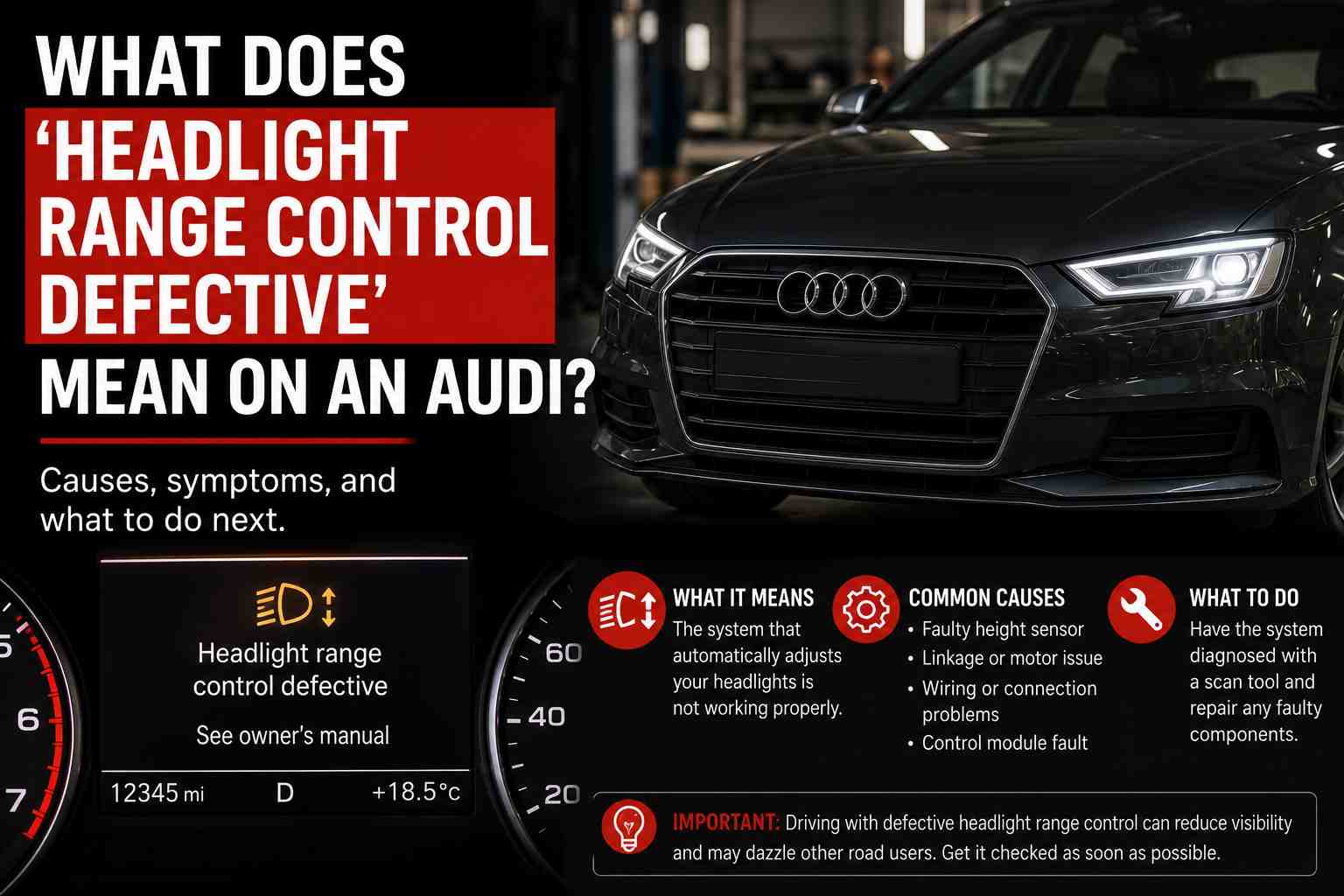
You’re driving your Audi at night. Suddenly, a warning pops up on your dash: “Headlight Range Control Defective.”
Now you’re worried. Is this serious? Can you keep driving? How much will this cost to fix?
Don’t panic. I’ve seen this warning hundreds of times in the shop. In most cases, it’s not dangerous. But you do need to understand what’s happening and get it fixed.
In this guide, I’ll explain exactly what this warning means, what causes it, and how to fix it. I’ll also tell you what you can do yourself and when you need a mechanic.
What Is Headlight Range Control?
Headlight range control is a safety feature on Audi vehicles. It automatically adjusts your headlight angle as you drive.
Think about what happens when you accelerate hard. The front of your car lifts slightly. Without adjustment, your headlights would point higher than normal. This could blind oncoming drivers.
The same thing happens when you load heavy items in the trunk. The rear drops down. The front rises. Your headlights point too high.
Audi’s headlight range control fixes this problem automatically.
How the System Works
The system uses sensors attached to your suspension. These sensors measure how your car is tilting.
Most Audis have two sensors. One sits near the front suspension. The other sits near the rear suspension. Some models with adaptive suspension have four sensors, one at each wheel.
These sensors send data to a control module. The control module then tells small motors inside your headlights to adjust the beam angle.
All of this happens automatically while you drive. You never notice it working until something goes wrong.
Static vs. Dynamic Systems
Audi uses two types of headlight range control.
Static systems adjust your headlights only when you start the car. They set the beam height based on how the car is loaded at that moment.
Dynamic systems adjust continuously while you drive. They respond in real time to acceleration, braking, and road conditions.
Dynamic systems are more complex. They have more parts that can fail. But they also give you better headlight performance.
What Causes the Defective Warning?
Several things can trigger the “Headlight Range Control Defective” warning. Here are the most common causes I see in the shop.
1. Broken or Damaged Level Sensor
This is the number one cause. The level sensors sit low on the car, near the suspension arms. They’re exposed to road debris, water, and salt.
The sensor has a small arm that connects to the suspension. This arm moves up and down as the suspension travels. Over time, this arm can break or disconnect.
I’ve also seen the sensor itself fail. Corrosion gets into the electrical connector. The internal electronics wear out.
2. Sensor Wiring Problems
The wires running to the sensors can get damaged. They rub against suspension parts. Road debris hits them. Corrosion builds up at the connectors.
A single broken wire will trigger the warning. So will a corroded connector that makes poor contact.
3. Recent Bumper or Headlight Work
Did you recently have body work done? Did someone replace your bumper or headlights?
The sensors and headlight motors need to be calibrated after this type of work. If the shop forgot to recalibrate, you’ll get the warning.
I’ve also seen this happen after someone changes their own headlight bulbs. They remove the headlight assembly but don’t reset the system afterward.
4. Lowered Suspension
If you lowered your Audi with coilovers or lowering springs, the sensors may struggle. The new ride height puts the sensors outside their normal operating range.
The sensors expect a certain amount of suspension travel. When you lower the car, you change that travel range. The system can’t calibrate properly.
5. Hitting a Big Bump or Pothole
Sometimes a hard hit confuses the sensors temporarily. You’re driving at highway speed. You hit a bump you didn’t see. The warning appears.
In this case, the warning often goes away after you restart the car. The sensors just got a momentary reading that didn’t make sense.
But if you hit something really hard, you may have actually damaged a sensor or its mounting.
6. Failed Headlight Motor
Each headlight has a small motor that tilts the beam up and down. These motors can fail over time.
When the motor fails, it can’t respond to the control module’s commands. The system detects this and triggers the warning.
Motor failure is less common than sensor failure. But it’s more expensive to fix because the motor is often built into the headlight assembly.
7. Control Module Problems
The control module that manages the system can also fail. It might have a software glitch. The electronics might be damaged.
Software issues can sometimes be fixed with a simple update. Hardware failures require replacing the module.
8. Outdated Software
Modern Audis run on sophisticated computer systems. Audi releases software updates to fix bugs and improve performance.
If your car hasn’t been updated in a while, a software glitch might cause the warning. This is more common in newer models with complex lighting systems.
Can You Drive With This Warning?
Yes, you can still drive your car. This is not a critical safety failure.
When the warning appears, your headlight range control is disabled. Your headlights will stay in a fixed position. They won’t adjust automatically anymore.
This is exactly how headlights worked on cars for decades. Before automatic systems existed, headlights just pointed where they were set.
When It’s Safe to Keep Driving
If your headlights are aimed correctly, you can drive normally. You might be inconveniencing other drivers slightly during acceleration or heavy braking. But it’s not dangerous.
Check your headlights at night. Park on flat ground facing a wall or garage door. Your headlight beams should cut off below eye level on other drivers.
If the beams look normal, you’re fine to drive while you arrange repairs.
When You Should Stop Driving
There are two situations where you should not drive at night.
First: If your headlights are pointing straight at the ground. Some sensor failures cause the headlights to drop to their lowest position. You’ll only see about 10 feet in front of the car. This is dangerous.
Second: If your headlights are pointing too high. You’ll blind every driver you meet. This is dangerous for them and could cause an accident.
In the UK, this issue can also cause your car to fail its MOT inspection. The self-leveling function must work on cars with xenon headlights. Get it fixed before your next MOT.
How to Diagnose the Problem
Before spending money on parts, you need to know what’s actually broken. Here’s how to figure it out.
Start With a Visual Inspection
Get under the car near the front and rear wheels. Look for the level sensors. They’re small units attached to the suspension with a thin arm connecting to the control arm or axle.
Check if the arm is still attached at both ends. A broken arm is easy to spot. It will hang loose or be missing entirely.
Look at the wiring going to the sensor. Check for damage, fraying, or corrosion at the connector.
Scan for Fault Codes
A basic OBD2 scanner won’t help much here. You need a scanner that can read Audi-specific systems.
VCDS (VAG-COM) from Ross-Tech is the most popular tool for Audi owners. OBDeleven is another good option that works with your smartphone.
Connect the scanner and read the fault codes from module 55 (Xenon Range). The codes will tell you exactly which sensor or component has failed.
Common fault codes include:
- 00496: Sensor for Vehicle Leveling Front
- 00497: Sensor for Vehicle Leveling Rear
- 01535: Control Circuit for Right Headlight Range Motor
- 01537: Vehicle Level Sensor Supply Voltage
Test the Sensors
With VCDS or OBDeleven, you can watch the sensor readings in real time.
Disconnect the sensor arm from the suspension. Move it up and down by hand. Watch the readings change on your scanner.
If the readings don’t change, the sensor is bad. If the readings change smoothly, the sensor is probably good.
Check for Recent Work
Think back to any recent repairs or modifications. Did you lower the car? Change the bumper? Replace headlights? Install aftermarket parts?
Any of these could be the root cause.
How to Fix It (DIY and Shop Options)
The fix depends on what’s broken. Let me walk through each scenario.
Replacing a Level Sensor (DIY Difficulty: Moderate)
If your sensor or its arm is broken, replacement is fairly straightforward.
What you’ll need:
- New sensor (get the correct part number for your specific Audi)
- Basic socket set
- Jack and jack stands
- VCDS or OBDeleven for recalibration
The process:
- Lift the car and remove the wheel for better access.
- Disconnect the electrical connector from the sensor.
- Remove the mounting bolts holding the sensor bracket.
- Disconnect the arm from the suspension link.
- Install the new sensor in reverse order.
- Use your scanner to recalibrate the system.
The front sensor is usually easier to access. The rear sensor can be tricky on some models. You may need to work around the fuel tank.
Plan for about an hour of work. Longer if it’s your first time or if the bolts are seized.
Clearing Codes After Repairs
After any headlight-related repair, you need to clear the fault codes and recalibrate the system.
With VCDS:
- Go to Module 55 (Xenon Range)
- Select Basic Settings (Group 04)
- Select “Basic headlamp setting”
- Click Go and wait for the process to complete
- Select “Acknowledge basic setting”
- Clear any remaining fault codes
This tells the system to relearn the current position of your car. The headlights will adjust properly after this.
When You Hit a Bump
If the warning appeared after hitting a bump, try this first:
- Park on level ground.
- Turn off the engine completely.
- Wait a few minutes.
- Start the car again.
Often, the warning will be gone. The sensors just got confused by the sudden impact.
If the warning keeps coming back, you likely have actual damage. Time for a closer inspection.
When to Take It to a Shop
Take your car to a shop if:
- You don’t have the right scanner.
- The sensor mounting bolts are seized or broken.
- The problem is inside the headlight assembly.
- You’re not comfortable working under the car.
An independent Euro shop is usually cheaper than the dealer. They’ll have the proper tools and experience.
Repair Cost Breakdown
Here’s what you can expect to pay for common fixes.
DIY Costs
| Part | Typical Price |
|---|---|
| Level sensor (aftermarket) | $30 – $60 |
| Level sensor (OEM) | $80 – $150 |
| Sensor link arm only | $15 – $40 |
| VCDS or OBDeleven tool | $100 – $200 (one-time purchase) |
Shop Costs
| Repair | Typical Price |
|---|---|
| Diagnostic scan | $50 – $100 |
| Sensor replacement (parts + labor) | $150 – $300 |
| System recalibration only | $50 – $100 |
| Headlight motor replacement | $500 – $1,500+ |
| Control module replacement | $300 – $600 |
Dealer prices are typically 30-50% higher than independent shops.
The headlight motor is expensive because you often can’t replace just the motor. You may need the entire headlight assembly. On older Audis, used assemblies from salvage yards can save a lot of money.
Common Mistakes to Avoid
I see these mistakes all the time. Don’t make them.
1. Ignoring the Warning
Yes, you can drive with it. But the longer you wait, the worse it can get. A loose sensor arm can break completely. Corroded wires can short out.
Fix it before a small problem becomes a big one.
2. Replacing Parts Without Diagnosis
Don’t guess. I’ve seen people replace the sensor, then the control module, then the headlight. All because they didn’t scan for codes first.
A $50 diagnosis can save you hundreds in unnecessary parts.
3. Using a Basic OBD2 Scanner
A cheap parts store scanner only reads engine codes. It can’t see the headlight system. You need an Audi-compatible tool.
4. Forgetting to Recalibrate
New sensors won’t work right until you recalibrate the system. This requires special software. Just clearing codes isn’t enough.
5. Installing the Wrong Parts
Audi uses different sensors for different models and years. The part numbers matter. Check your VIN to get the exact right part.
6. Not Checking Wiring
A new sensor won’t fix a wiring problem. Always inspect the wires and connectors before replacing parts.
Frequently Asked Questions
Is “Headlight Range Control Defective” dangerous?
No, not in itself. Your headlights will still work. They just won’t adjust automatically. If they’re aimed correctly, you can drive safely. If they’re pointing too high or too low, fix it immediately.
Will my car fail the MOT with this warning?
In the UK, possibly yes. Cars with self-leveling headlights must have working automatic adjustment. The MOT tester will check this function.
How do I know if my headlights are aimed correctly?
Park on flat ground about 25 feet from a wall. The top of your headlight beam should be at or below the height of your headlight housings. If the beams are too high, you’ll blind other drivers.
Can I just disconnect the system?
Technically yes, but I don’t recommend it. The system is there for safety. Also, disconnecting it won’t remove the warning light.
Why did this happen after lowering my car?
Lowering your car changes the suspension geometry. The sensors may be outside their normal range. You’ll need to have the system recalibrated for the new ride height. Some extremely low setups may never work properly.
Can a dead battery cause this warning?
Sometimes. A low battery can cause strange electrical issues. If you recently had a dead battery, try driving for a while to let the system reset. If the warning persists, there’s a real problem.
How long does the sensor last?
Typically 8-15 years or 100,000+ miles. They’re fairly durable. Road conditions and climate affect longevity. Cars in salty or wet climates see more sensor failures.
Should I go to the dealer?
Not necessarily. Any good Euro shop can fix this. Dealers charge premium prices. An independent specialist with the right tools will save you money.
Conclusion
The “Headlight Range Control Defective” warning on your Audi is annoying but fixable. In most cases, you’re looking at a failed level sensor or its wiring.
Here’s what to do:
- Check your headlight aim. If it’s normal, you can keep driving safely.
- Get a proper diagnostic scan. Know exactly what’s wrong before buying parts.
- Start with the sensors. They’re the most common failure point.
- Don’t forget recalibration. Use VCDS or OBDeleven to reset the system.
The fix is usually under $300 at an independent shop. DIY repairs can cost under $100 in parts if you have the right scanner.
Don’t ignore this warning forever. Your headlights are important for safety. Fix the problem and get back to enjoying your Audi at night.