
Monday to Saturday - 9:00 am -18:00 pm

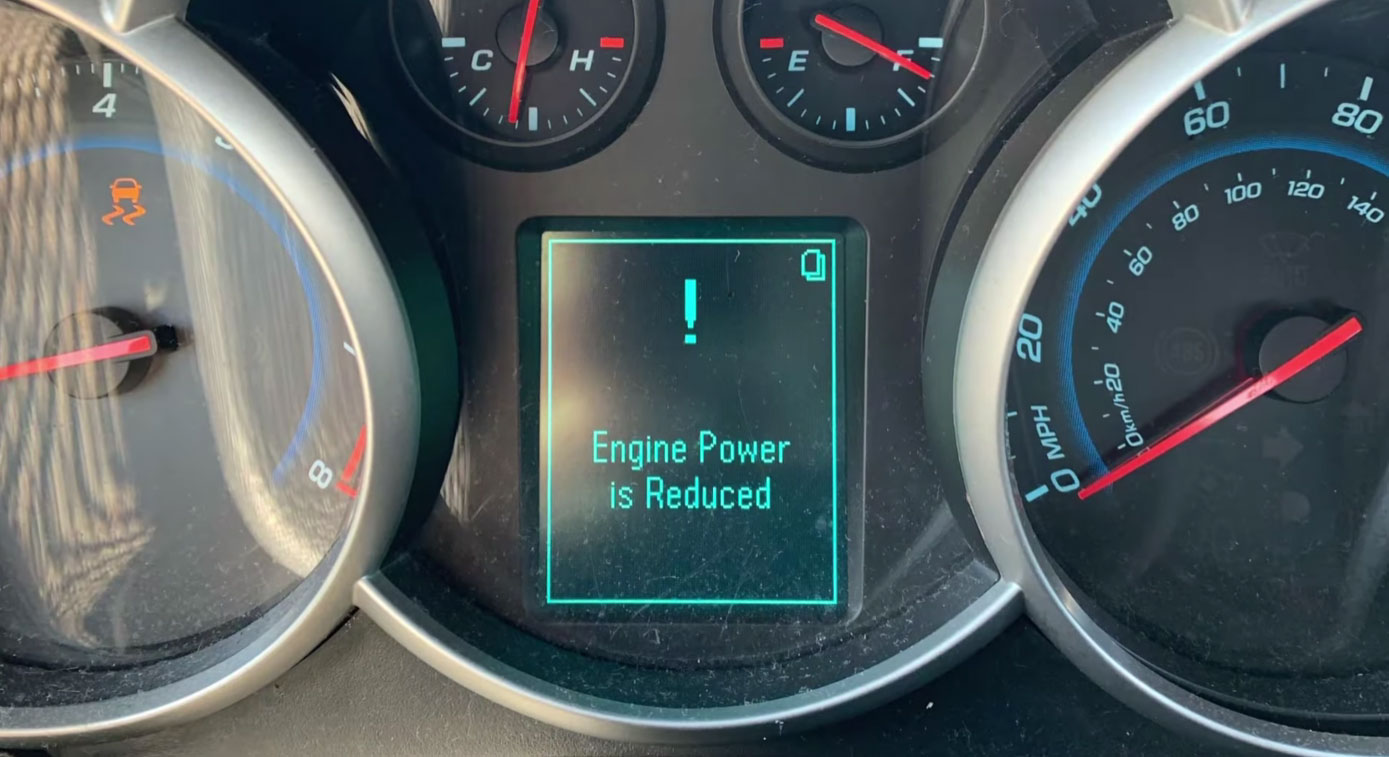
The “Engine Power Reduced” light on your Chevy Cruze dashboard can feel scary. You might think your engine is dying. The good news: it usually isn’t.
This is your car’s safety system talking. When something goes wrong—or could go wrong—your Cruze automatically limits engine power. Think of it like a bouncer stopping you before you cause trouble.
But here’s what matters: What caused it? And is it safe to drive?
This guide explains exactly what this warning means, why it happens, and what you should do right now. You’ll learn the most common causes (some cheap to fix, some more serious), and I’ll tell you honestly whether you can keep driving or need to pull over.
What “Engine Power Reduced” Actually Means
Your Chevy Cruze has a computer that watches everything. It monitors your engine, transmission, emissions, cooling system, and more.
When this computer detects a problem—even a small one—it doesn’t want to risk damage. So it does two things:
1. Lights up the warning on your dashboard. 2. Reduces engine power to protect itself.
This is called “limp mode” or “reduced power mode.”
The computer is basically saying: “Something is wrong. I’m making your car less powerful so nothing gets worse while you get help.”
Think of it like a phone dropping to low-power mode when the battery is weak. It’s not broken. It’s protecting itself.
Why Your Chevy Cruze Triggered This Warning
The “Engine Power Reduced” warning appears for one reason: Your engine computer found a fault code.
A fault code is like an error message. The computer detected something abnormal. It could be:
- A sensor acting up
- An electrical connection loose
- An exhaust problem
- A transmission glitch
- A cooling system issue
- Low fuel pressure
The computer doesn’t know if this problem is dangerous or just annoying. So it plays it safe and reduces power.
This is actually good. It stops you from driving dangerously without knowing it.
Common Causes (And How to Tell Which One)
I’ve seen this warning on hundreds of Cruzes. Here are the actual causes that show up over and over.
1. Loose or Corroded Gas Cap
How common: Very common. Seriously.
Your gas cap isn’t just decorative. It seals your fuel tank and keeps the fuel system pressure correct. A loose cap throws off the pressure sensor, which triggers the warning.
How to check:
- Stop at a safe place.
- Open your fuel door (usually on the side of your car).
- Unscrew the cap.
- Look at the rubber seal. Is it cracked or dry?
- Screw it back on firmly until you hear a click.
Cost to fix: $0 to $20 (cap replacement only).
How long it takes: 30 seconds.
2. Oxygen Sensor Failure
How common: Very common on Cruzes with over 80,000 miles.
Your oxygen sensors tell the engine computer how much oxygen is in your exhaust. This helps the engine run efficiently.
When an oxygen sensor dies, the computer can’t read the exhaust properly. It triggers reduced power mode.
How to tell:
- Does your car feel sluggish?
- Is your fuel economy worse than normal?
- Are you hearing a weird sound from under the car?
Cost to fix: $150 to $400 per sensor (parts and labor).
How long it takes: 1 to 2 hours at a shop.
Why it matters: Driving with a dead O2 sensor will damage your catalytic converter. That’s a $500–$1,500 part. Fix this quickly.
3. Catalytic Converter Problem
How common: Fairly common.
Your catalytic converter cleans up your exhaust. If it’s clogged or failing, the computer limits power to protect the engine.
How to tell:
- Your car feels weak, especially when accelerating.
- You might hear rattling under the car.
- Your fuel economy drops hard.
Cost to fix: $400 to $1,500 (this is expensive).
How long it takes: 2 to 4 hours.
Why it matters: Ignore this and you’ll overheat your catalytic converter. Then it fails completely and costs way more.
4. Mass Air Flow (MAF) Sensor Issue
How common: Common on higher-mileage Cruzes.
The MAF sensor measures air going into the engine. It’s very sensitive and can get dirty or fail.
How to tell:
- Your engine might run rough or sputter.
- Power drops noticeably.
- Fuel economy gets worse.
Cost to fix: $150 to $400 (cleaning is cheaper than replacement).
How long it takes: 30 minutes to 1 hour.
Why it matters: A bad MAF sensor can cause all kinds of running problems. Fix it early.
5. Transmission Issues
How common: Less common, but serious when it happens.
If your transmission has a problem, the computer triggers reduced power to stop damage.
How to tell:
- Your car might not shift smoothly.
- You might feel jerking when accelerating.
- The engine warning light plus another light (transmission light) might be on.
Cost to fix: $200 to $2,000+ (depends on the problem).
How long it takes: 1 hour to several hours.
Why it matters: Transmission problems get worse fast. Don’t ignore this.
6. Coolant Temperature Sensor
How common: Moderately common.
This sensor tells your engine how hot it is. A bad sensor might read a false “overheating” warning, triggering reduced power.
How to tell:
- Your car might feel underpowered.
- Temperature gauge might look wrong.
- You might see overheating warnings.
Cost to fix: $100 to $300.
How long it takes: 30 minutes to 1 hour.
Why it matters: If this sensor is wrong, the computer thinks you’re overheating when you’re not. It’s not actually dangerous, but you need it fixed to get full power back.
7. Bad Spark Plugs or Ignition Coil
How common: Fairly common on older Cruzes.
Spark plugs ignite fuel in your cylinders. If they’re worn out or coils fail, the engine misfires and the computer steps in.
How to tell:
- Rough idle (shaking while stopped).
- Hesitation when accelerating.
- Engine might shake or sputter.
Cost to fix: $100 to $400 (spark plugs are cheap; ignition coils cost more).
How long it takes: 30 minutes to 2 hours.
Why it matters: Misfires damage your catalytic converter over time. Fix this quickly.
Is It Safe to Drive?
Here’s the honest answer: Maybe. It depends on the cause.
Safe to Drive (Short Distance Only)
You can probably drive carefully to a repair shop if:
- Only the power reduction warning is on (no overheating gauge, no oil light).
- Your engine sounds normal.
- Your car isn’t overheating.
- Your transmission is shifting normally.
- You’re not seeing smoke or smelling anything weird.
But:
- Go slowly. No highway speeds.
- Don’t floor the accelerator.
- Drive straight to a mechanic.
- Don’t use it for weeks. Get it fixed soon.
DO NOT Drive If You See These Signs
Pull over immediately and call a tow truck if:
- Your temperature gauge is climbing toward the red zone (overheating).
- You smell burning rubber or hot oil.
- You see smoke under the hood.
- Your engine is shaking violently (severe misfire).
- Your transmission isn’t shifting.
- Your oil pressure light is on.
- You hear loud knocking or rattling from the engine.
These mean real damage is happening right now. Driving makes it worse.
Why the Computer Does This
The “Engine Power Reduced” warning is your car saying, “Something is wrong. I’m protecting myself until you fix it.”
It’s not trying to ruin your day. It’s trying to keep the engine from blowing up.
If you ignore it and keep driving hard, you could turn a $300 repair into a $3,000 repair.
What to Do Right Now
Step 1: Pull over safely.
Don’t panic. Find a safe place to stop—a parking lot, side road, or safe shoulder.
Step 2: Check the obvious.
- Is your gas cap tight? Tighten it and wait 30 seconds. Sometimes the warning clears.
- Does your car feel normal otherwise?
- Are you overheating?
Step 3: Restart the engine.
Turn the car off completely. Wait 10 seconds. Start it again.
Sometimes the computer resets itself. The warning might go away.
Step 4: Check your fuel level.
Very low fuel can trigger this warning on some Cruzes. If your tank is near empty, fill up and see if it clears.
Step 5: Read the fault code (if you can).
If you have an OBD-II scanner (or a friend does), plug it in and read the code. This tells you exactly what’s wrong.
No scanner? Go to:
- An auto parts store (many read codes free).
- A mechanic (costs $50–$100 for diagnosis).
- A dealer (costs more but they have all the information).
Step 6: Plan your repair.
Based on the fault code:
- If it’s simple (gas cap, sensor), you might fix it today.
- If it’s complex (transmission, catalytic converter), budget for a shop visit.
- If it’s expensive, get a second opinion.
Step 7: Get it fixed soon.
Don’t drive on this warning for weeks. Each day you drive, you risk making the problem worse.
Common Mistakes Drivers Make
Mistake 1: Ignoring It and Hoping It Goes Away
Wrong. This warning won’t go away on its own. The problem doesn’t fix itself.
Driving with reduced power for weeks can turn a small problem into a big one. The catalytic converter, transmission, or engine could fail.
Right move: Get it diagnosed within a few days.
Mistake 2: Panicking and Thinking Your Engine Is Dying
Wrong. Usually it’s not.
Most “Engine Power Reduced” warnings are simple fixes: a sensor, a plug, a cap. Your engine is probably fine.
Right move: Stay calm. Get it checked. Most Cruzes run fine after diagnosis and repair.
Mistake 3: Driving It Like Nothing’s Wrong
Wrong. This warning means reduce your driving.
If you keep flooring the accelerator or towing a trailer, you’ll make the problem worse.
Right move: Drive gently and slowly. Get to a mechanic.
Mistake 4: Going to a Dealer Without Trying a Shop First
Not wrong, but expensive.
Dealers charge more. Independent mechanics often cost less for the same repair.
Get a diagnosis at a shop first. If it’s complicated, then ask about the dealer.
Right move: Call a trusted local mechanic. Ask the price before work starts.
Mistake 5: Not Getting a Second Opinion on Expensive Fixes
Wrong. If someone says you need a $1,500 catalytic converter, get another opinion.
Some shops oversell repairs. Others miss the real problem.
Right move: For repairs over $500, get a second diagnosis.
FAQ
Q: My gas cap was loose. I tightened it. Will the warning go away?
A: Maybe. Give it a few driving cycles (start and stop the engine 5–10 times). The computer should clear the code on its own. If it doesn’t, something else is wrong.
Q: Can I drive my Chevy Cruze 100 miles with this warning on?
A: Not safely. Short trips to a mechanic are okay. Long highway drives risk expensive damage. Your power is limited on purpose—the computer is protecting your engine. Don’t push it.
Q: How much does it cost to fix “Engine Power Reduced”?
A: $0 to $2,000+, depending on the cause.
- Gas cap: $0–$20
- Sensor cleaning or replacement: $100–$400
- Spark plugs/coils: $100–$400
- Catalytic converter: $400–$1,500
- Transmission issue: $200–$2,000+
Always get a diagnosis first. The repair cost depends entirely on what’s wrong.
Q: Will this damage my engine if I keep driving?
A: Possibly. If you ignore it for weeks, yes. Short-term driving with reduced power won’t destroy anything. But the longer you wait, the higher the risk. Some problems (catalytic converters, transmissions) get worse quickly.
Q: My mechanic says I need a catalytic converter. Is it really necessary?
A: Probably yes, but get a second opinion.
A bad catalytic converter:
- Causes power loss
- Fails emissions tests
- Can overheat and damage the engine
- Is very expensive to replace later if ignored
But: Some mechanics oversell repairs. Have another shop look at it. Most are honest. Some aren’t.
Q: Can I clear this code myself without fixing it?
A: You can reset the warning. But it will come back.
Using an OBD-II scanner to clear the code is like silencing a smoke alarm when there’s a fire. The problem is still there.
Fix the actual problem. Then the code stays gone for good.
Q: Is the “Engine Power Reduced” warning the same as the “Check Engine” light?
A: Not quite. They’re related but different.
- Check Engine light: Something is wrong. Engine still runs normally.
- Engine Power Reduced warning: Something is wrong AND the computer has limited your power to protect the engine.
“Engine Power Reduced” is more serious. You should address it faster.
Q: My dashboard shows multiple warning lights. Is this worse?
A: It could be. Multiple lights suggest multiple problems or one big problem affecting several systems.
Get a full diagnostic scan. One problem can trigger several codes. Or you could have multiple issues.
Don’t guess. Scan it. Know what you’re dealing with.
Conclusion
The “Engine Power Reduced” warning on your Chevy Cruze is your car’s way of saying, “Something’s wrong. I’m protecting myself until you fix it.”
It’s not a death sentence. Most causes are simple and affordable.
Here’s what to do:
- Don’t panic. Pull over safely.
- Check the obvious. Is your gas cap tight? Are you overheating?
- Get a diagnosis. Read the fault code at a shop or with a scanner.
- Fix it soon. Don’t drive on this warning for weeks.
- Be honest with yourself about the cost. Some repairs are expensive, but ignoring them is worse.
The bottom line: You can probably drive carefully to a mechanic. But get it diagnosed and fixed within a few days. The longer you wait, the more damage can happen—and the more it will cost.
If you’re unsure whether it’s safe to drive, call a mechanic or get it towed. A $100 tow is cheaper than a $5,000 engine repair.
Get it fixed. Get your power back. Drive normally again.