
Monday to Saturday - 9:00 am -18:00 pm

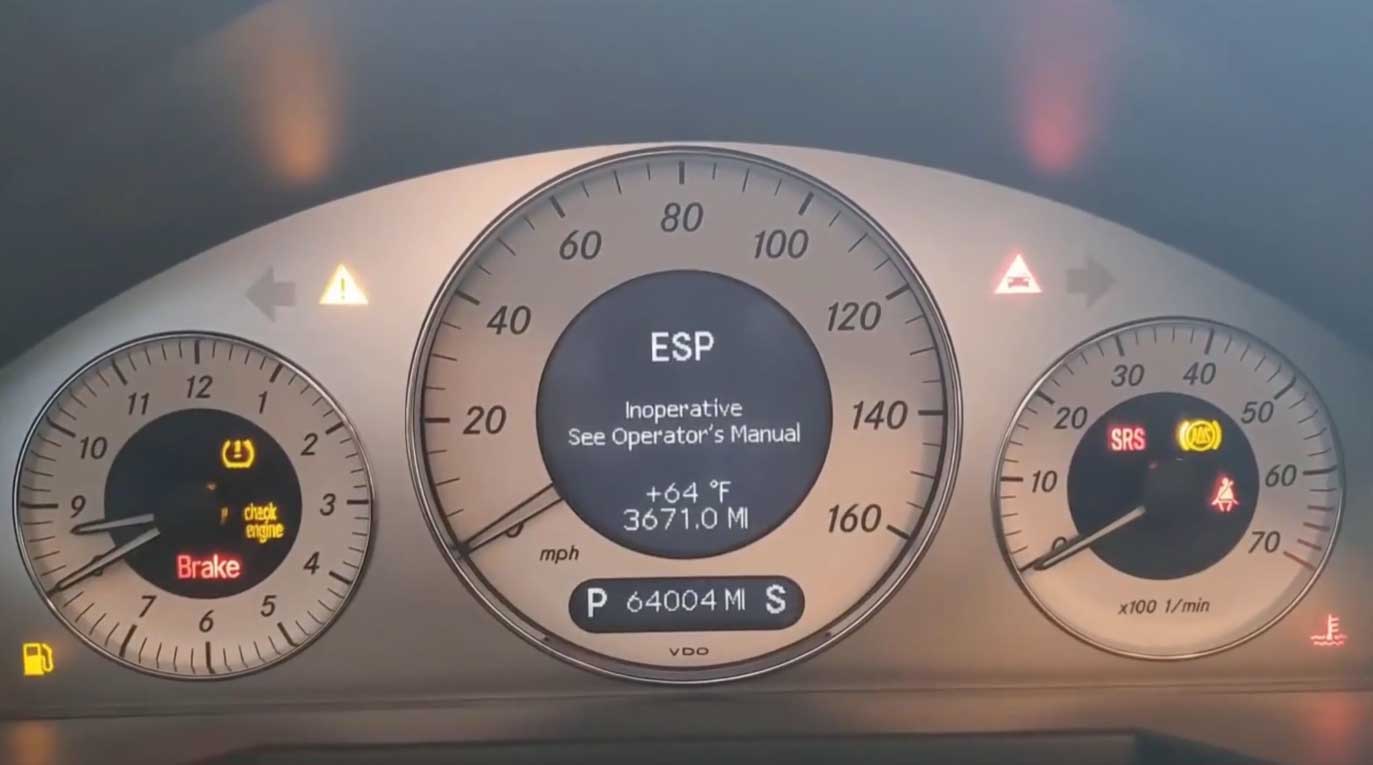
Your Mercedes dashboard just lit up with “ESP Inoperative” or an ESP warning light. Your first thought is probably panic. Don’t worry. I’ve worked on hundreds of Mercedes with this exact problem, and most of the time it’s fixable.
The short answer: No, it’s not ideal to drive, but your car won’t fall apart tomorrow. However, you’ve lost important safety features. You need to understand what happened and get it fixed.
In this guide, I’ll explain exactly what ESP does, why the light came on, whether it’s safe to drive, and what your next move should be.
What Is Mercedes ESP?
ESP stands for Electronic Stability Program. It’s not a luxury feature—it’s a safety system.
Here’s what it does: When you hit a slippery patch of road, a pothole, or you have to swerve suddenly, ESP detects wheel slip. It then brakes individual wheels and adjusts engine power to keep all four wheels pointed where you want them. It happens in milliseconds.
Think of it like this. Your car has sensors on every wheel that measure how fast each one is spinning. If one wheel is spinning faster than the others (meaning it’s slipping), ESP knows there’s a problem. It steps in and fixes it.
You notice it most on wet roads. When you feel the brake pedal pulsing gently under your foot during a skid, that’s ESP working. It’s supposed to happen.
Without ESP working, your car can slide, lose traction, and go where you didn’t intend in an emergency. Modern cars are built around the assumption that ESP is working.
ESP Inoperative vs. ESP Flashing: What’s the Difference?
This matters. A lot.
ESP Light Flashing (Blinking): The system is ON and actively working. This is normal. You’re probably driving on snow, ice, wet pavement, or pushing the car hard through a corner. Let off the gas and drive smoothly. The light will stop.
ESP Light Solid (Stays On): This means the system has been disabled or it has detected a problem it can’t fix. This is the warning you’re concerned about.
The message might say:
- “ESP Inoperative”
- “ESP Unavailable”
- “ABS, ESP Inoperative”
- “See Owner’s Manual”
All of these point to the same problem: something is broken, and you need to find out what.
Is It Safe to Drive with ESP Inoperative?
I’ll be honest with you.
Yes, your car will drive. The engine starts. You can press the accelerator. Brakes work normally. You can get to work.
But no, it’s not ideal. You’ve lost a critical safety net.
Without ESP, here’s what changes:
- On wet roads, your car will slide more easily if you brake hard
- In corners, you have less grip (the system can’t help you anymore)
- If a wheel starts to slip, there’s nothing automatically correcting it
- In an emergency swerve, the car might not respond the way it did before
- You can’t use cruise control on many newer Mercedes (it needs ESP to work)
In normal, dry conditions, driving to the mechanic is fine. Most people drive like this for a day or two without incident.
In rain, snow, or if you have to brake suddenly, the risk goes up. A lot.
I always tell owners: “Get it fixed within a few days. Don’t ignore it for weeks.”
Why Your ESP Light Came On (Real Causes)
The ESP system relies on multiple sensors and modules working together. When one fails, the whole system shuts down. That’s a safety feature—Mercedes would rather shut it off than let a broken system make things worse.
The ESP system includes:
- ABS sensors on each wheel (wheel speed sensors)
- Steering angle sensor (measures which direction the wheels point)
- Yaw rate sensor (measures rotation/spin)
- ESP control module (the computer)
- ABS hydraulic unit (applies brakes to each wheel)
- Battery and alternator (power supply)
- Wiring and connectors (carry signals between parts)
If ANY of these fail, ESP shuts down.
The Most Common Causes (in Order of Likelihood)
I’ve seen thousands of these. Here’s what actually causes the light to come on.
1. Faulty Wheel Speed Sensor (Most Common)
An ABS sensor sits on the wheel hub and counts how fast the wheel spins. It’s one of the most common parts to fail on a Mercedes.
Why it fails:
- Age. The sensor itself wears out.
- Road salt (UK and winter climates). Salt corrodes the sensor and connector.
- Dirty connectors. Corrosion on the connector prevents the signal from getting through.
- Physical damage. A rock hit the sensor during driving.
What it feels like:
- ESP light comes on (sometimes flashing first)
- Sometimes steering wheel feels slightly stiff
- ABS light may also come on
- Everything else seems fine
Cost to fix: Around $150–$350 per wheel to replace the sensor (parts and labor). A four-wheel sensor reset is cheaper than replacement if it’s just a connector issue.
What to do: Have a shop read the fault codes. The scanner will tell you which wheel has the bad sensor. That narrows it down instantly.
2. Dead or Weak Battery
This one surprises people, but I see it constantly.
A weak battery can’t power all of Mercedes’s computers properly. The ESP control module needs stable voltage. If voltage drops below a certain point, the system disables itself.
What it feels like:
- ESP light comes on
- Sometimes steering feels stiff (power steering loses assist)
- Car might feel slow or sluggish
- Battery warning light might also be on
Quick test: Turn the headlights on. Are they dim? Does the car crank slowly? That’s a battery sign.
Cost to fix: $150–$250 for a new Mercedes battery, plus installation.
What to do: Before you do anything else, get a battery test. Many shops test it free. A battery over 6 years old is suspicious.
3. Faulty Brake Light Switch
This is cheap and often overlooked.
The brake light switch tells the car when you’re pressing the brake pedal. ESP uses this signal. If the switch fails, ESP thinks something is wrong and shuts down.
What it feels like:
- ESP and ABS lights come on together
- Brake lights might not work (or work inconsistently)
- Everything else feels fine while driving
Cost to fix: $20 for the part. $100–$150 with labor.
What to do: Check your brake lights. Do they work? Does a friend see them light up? If not, the switch is bad. It’s under the dashboard, super cheap to replace.
4. Steering Angle Sensor Out of Calibration
The steering angle sensor tells ESP which direction the front wheels are pointed. If the battery was recently disconnected (during service or after an accident), this sensor loses calibration.
What it feels like:
- ESP light is on
- Everything else works fine
- The problem started after a mechanic worked on the car
Quick fix: Start the engine. Turn the steering wheel all the way left. Then all the way right. Do this 3–4 times slowly. Turn off the engine. Restart. The light might disappear.
This works about 40% of the time for this specific problem.
Cost if it doesn’t work: $150–$300 to recalibrate with a scanner. Sometimes the sensor itself is bad (another $300–$500).
5. ESP Control Module Failure
The ESP control module is a computer that processes all the sensor signals. If it fails, the light comes on.
What it feels like:
- ESP light is solid
- You’ve ruled out all the other causes
- Fault code points to the module itself
Cost to fix: This is expensive. $800–$2,000 depending on the part and labor.
Some shops can repair modules cheaper. Some can reprogram a used module from a junkyard car.
What to do: Get a full diagnostic before accepting this. Make sure it’s really the module and not a sensor you can replace for $150.
6. Corroded or Damaged Wiring
ESP runs on a network of wires and connectors. Corrosion or damage can break the signal.
Where to look:
- Around the wheel hubs (sensor connectors)
- Under the ABS pump
- In the engine bay near the battery
Road salt and pressure washing are the main culprits.
Cost to fix: $100–$500 depending on how bad the corrosion is. Sometimes just cleaning a connector fixes it.
What to Check Before the Mechanic
You don’t need to be a mechanic to spot obvious problems. A 10-minute check might save you money.
Check 1: The Battery
Pop the hood. Look at the battery terminals. Are they covered in white, blue, or green crusty stuff? That’s corrosion. Disconnect the negative terminal, clean both terminals with a wire brush, and reconnect. Restart the car.
Sometimes that’s all it takes.
Check 2: The Brake Light Switch
Get in the car. Have a friend stand behind you and watch the brake lights. Press the pedal hard a few times. Do the lights come on every time? Or inconsistently?
If they’re flickering or not working, the switch is bad. It’s $20 and takes 15 minutes to replace.
Check 3: The Steering Angle Sensor Reset
Start the engine. Turn the wheel all the way left. Count to two. Turn all the way right. Count to two. Repeat 4 times. Turn off the engine. Wait 10 seconds. Restart.
Check if the light is gone.
Check 4: Look for Obvious Damage
Look at each wheel. Is there any visible damage to the sensor area (a little box on the back of the wheel hub)? Any loose wires? Any damage after going over a pothole recently?
Check 5: Check for Loose Connections
Pop the hood. Look for any loose or corroded connectors near the ABS pump (usually near the battery or on the firewall). Try pushing connectors in firmly.
How Much It Costs to Fix
I’ll give you the real numbers based on what I see.
| Problem | Parts | Labor | Total |
|---|---|---|---|
| Wheel speed sensor | $80–$150 | $80–$100 | $150–$250 |
| Brake light switch | $20 | $80–$100 | $100–$150 |
| Battery | $150–$250 | $50–$100 | $200–$350 |
| Steering angle sensor replacement | $200–$400 | $150–$250 | $350–$650 |
| Wiring/connector repair | $50–$200 | $100–$300 | $150–$500 |
| ESP control module (replace) | $500–$1,200 | $300–$500 | $800–$1,700 |
| ESP control module (repair/reman) | $200–$400 | $150–$250 | $350–$650 |
Most of the time, you’re looking at $150–$350 to fix it.
If the control module is bad, you can sometimes save money by:
- Buying a used module from a junkyard ($150–$300) and having it reprogrammed
- Using a remanufactured module (Module Masters, BBA Reman, etc.) instead of a new OEM part
Common Mistakes Owners Make
Mistake 1: Ignoring It for Months
I see owners drive with the ESP light on for 6 months. Then the ABS light comes on. Then the brakes feel weird. Then they come to the shop and say, “I don’t know what went wrong.”
The problem got worse because they ignored the first sign.
Fix it in the first week. Seriously.
Mistake 2: Assuming the Worst
When the ESP light comes on, owners think the entire car is broken. They Google it and see forum posts about $2,000 module replacements. They panic.
99% of the time, it’s a $200 sensor or a corroded connector.
Get a diagnostic scan ($100–$150). It takes 15 minutes. You’ll know exactly what’s wrong.
Mistake 3: Going to the Wrong Shop
Some shops will tell you, “Oh, that’s a complex system. You need us for $1,500.” Then they replace the control module without testing anything else.
Go to a Mercedes specialist or a shop that specializes in diagnostics. They’ll actually read the fault codes instead of guessing.
Mistake 4: Pressure Washing Near the Sensors
I know it’s tempting to power wash the undercarriage. Don’t aim the nozzle at the wheel hubs or the ABS pump. The high pressure forces water into sensor connectors and causes corrosion.
If you must wash, use a garden hose and low pressure. Or just avoid the area.
Mistake 5: Disconnecting the Battery Without a Proper Reset
If a mechanic worked on your car and the battery was disconnected, the steering angle sensor loses its calibration. Some mechanics forget to recalibrate it.
If the light came on right after service, call them back. It might be a free 10-minute fix.
Common Myths About ESP
Myth 1: “I can just turn off ESP to make the light go away.”
False. You CAN press the ESP Off button to disable the system (useful in deep snow or mud). But the light will still be on. Turning it off doesn’t fix the underlying problem.
Myth 2: “ESP is not important. I can ignore it.”
False. It’s one of the most important safety systems on modern cars. In wet conditions, it’s the difference between staying in your lane and hitting another car.
Myth 3: “The light will go away on its own.”
False. Once a sensor fails, it stays failed. The light won’t disappear until you fix the problem.
Myth 4: “I need a $2,000 repair.”
Usually false. Expensive module problems are rare. Most people spend $150–$400.
Myth 5: “I have to go to the Mercedes dealership.”
False. A good independent shop can diagnose and fix this cheaper than the dealership. You don’t need the official Mercedes scanner if the shop has a quality aftermarket scanner.
FAQ
Q1: Is it safe to drive with the ESP light on?
A: For a short distance (a few miles), yes. For daily driving over weeks, no. You’ve lost a critical safety feature. Get it fixed within a few days.
Q2: Can a weak battery cause the ESP light to come on?
A: Yes. Low voltage causes multiple warning lights. Get your battery tested first.
Q3: Do I need to go to a Mercedes dealership?
A: No. Any mechanic with a diagnostic scanner can read the fault codes. Independent shops are usually cheaper. Dealerships charge premium labor rates.
Q4: How long does the repair take?
A: If it’s a sensor, 1–2 hours. If it’s a module replacement, 2–4 hours. If it’s just a brake light switch, 15 minutes.
Q5: Can I clear the fault codes myself?
A: You can clear them with an OBD-II scanner ($50 online). But if the underlying problem isn’t fixed, the light comes back on. Don’t waste time clearing codes—fix the problem.
Q6: What’s the difference between “ESP Inoperative” and “ESP Unavailable”?
A: Usually nothing. Both mean the system is disabled due to a fault. The exact wording varies by Mercedes model year.
Q7: Will the ESP light come on again after repair?
A: Not if the problem was actually fixed. If the light comes back on a week later, the repair didn’t address the root cause.
Q8: Can I get a refund if the shop fixes it wrong?
A: Most reputable shops offer a warranty on repairs (30–90 days). If the light comes back on, take it back. They should re-diagnose for free.
What You Should Do Right Now
Step 1: Pull over if you’re in traffic.
If the light just came on, find a safe place to stop. Turn off the engine. Wait 30 seconds. Restart.
Sometimes the light disappears (false alarm). If it comes back on, move to the next step.
Step 2: Check the basics at home.
Spend 10 minutes checking:
- Battery terminal corrosion (clean if needed)
- Brake lights (do they work?)
- Loose connectors under the hood
Step 3: Get a diagnostic scan.
This is mandatory. Call a local shop and ask: “How much for an ESP/ABS fault code diagnostic scan?”
Expect $100–$150. Take it there. They’ll tell you exactly what’s wrong in 20 minutes.
Do NOT let them sell you a repair until they’ve scanned it.
Step 4: Compare quotes.
Once you know what’s broken, get quotes from 2–3 shops. Prices vary a lot.
Ask: “What’s included in your warranty?” A good shop gives 30–90 days.
Step 5: Get it fixed this week.
Don’t delay. The longer you wait, the higher the risk of other systems failing.
Final Thoughts
The ESP light is a messenger. It’s telling you something is broken. It’s not a catastrophe, and it’s not your fault.
Most owners I’ve worked with are surprised at how cheap and quick the fix actually is. You’re probably looking at a sensor replacement ($150–$300) or a battery issue ($200–$350).
The worst thing you can do is ignore it or drive hard in wet weather. The best thing is to get a diagnostic scan this week and fix it.
Your Mercedes is built to be safe when all its systems are working together. Get the ESP system working again, and your car will be back to normal.
Any questions? Take it to a shop. A good mechanic is always faster than an internet search.
About This Article:
This guide is based on years of hands-on experience diagnosing and repairing Mercedes-Benz ESP and ABS systems. All information reflects real diagnostic procedures and repair costs from independent shops and Mercedes specialists across the US and UK.
If you have a specific fault code or your situation is different, get a professional diagnostic scan. Every car is different, and the scan will give you the exact answer.