
Monday to Saturday - 9:00 am -18:00 pm

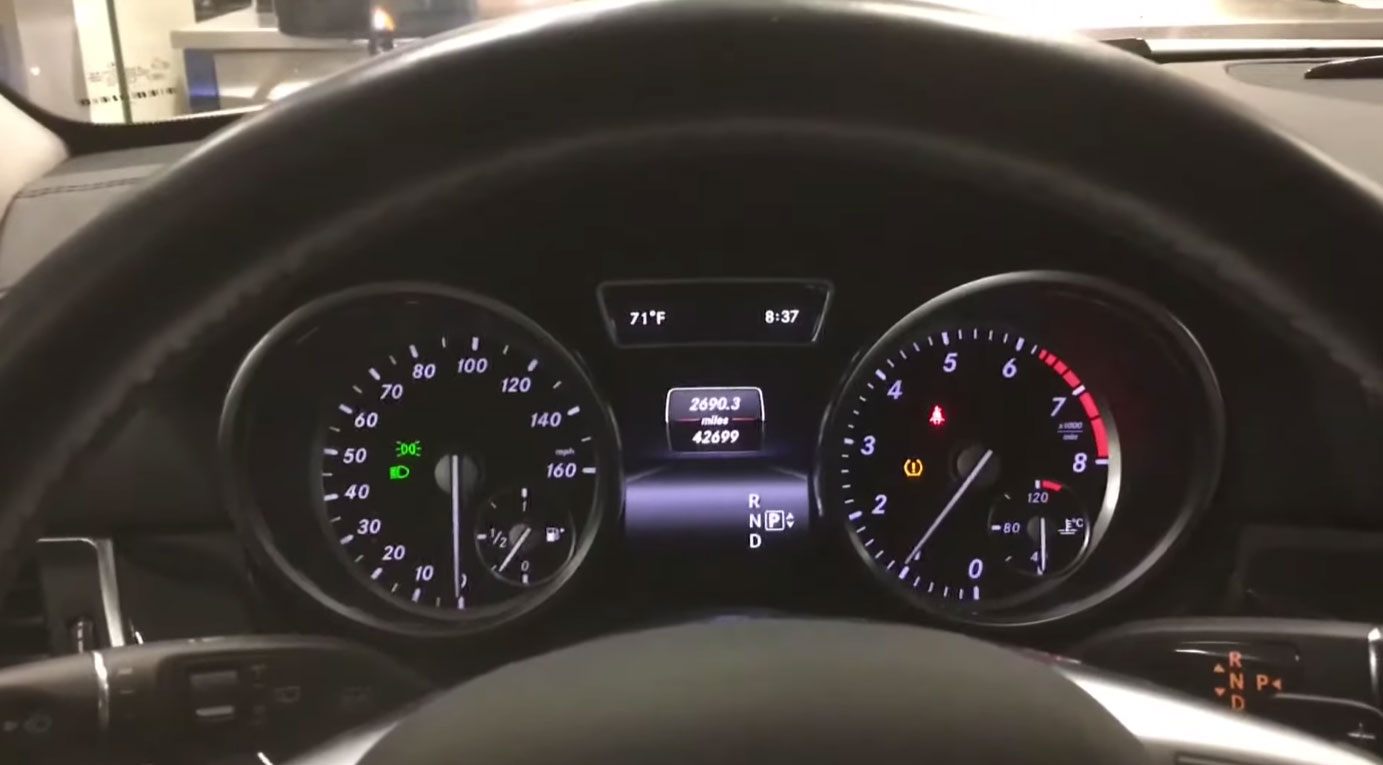
The tire pressure warning light pops up on your dashboard. You fill your tires. The light goes away. Then three days later—there it is again. Frustrating, right?
If you own a Mercedes, you’re not alone. This happens to thousands of owners. The good news? There’s always a reason. And most of the time, you can fix it yourself.
This guide explains the real causes behind your Mercedes tire pressure warning. You’ll learn how to diagnose the problem in your driveway. And you’ll know exactly when to call a professional.
How Your Mercedes Tire Pressure System Works
Your Mercedes has a safety system called TPMS. That stands for Tire Pressure Monitoring System.
Here’s what it does:
Inside each of your four tires is a small sensor. This sensor constantly checks the air pressure. It sends signals wirelessly to a control module in your car. If the pressure drops too low, the module alerts you with a warning light on your dashboard.
This system is smart. It’s designed to catch problems before they become dangerous. A tire that’s too low can overheat, fail suddenly, and cause a blowout. The TPMS warns you before that happens.
But here’s the catch: the system is also sensitive.
It can trigger false alarms. It can pick up real problems you didn’t know about. And sometimes, it stays stuck in “alert mode” even after you fix the problem.
That’s why your warning keeps coming back.
The Five Real Reasons Your Warning Keeps Coming Back
I’ve diagnosed thousands of tire pressure issues in my shop. Here are the actual causes I see most often.
1. Your Tires Actually Have a Slow Leak (The Most Common)
This is number one because it’s the reason in about 40% of cases.
A slow leak isn’t always obvious. You might not see a nail or puncture. But your tire is definitely losing air. Every few days, the pressure drops just enough to trigger the warning.
How to check:
- Use a tire pressure gauge (get a digital one—they’re accurate and cheap).
- Check all four tires when they’re cold. Cold means parked overnight or at least three hours without driving.
- Write down the numbers.
- Recheck them a few days later.
If the numbers drop between checks, you have a leak.
Where leaks happen:
- Tiny puncture in the tread (like a nail)
- Leak around the valve stem (the little metal stick you unscrew to add air)
- Crack in the tire sidewall
- Separation where the tire separates from the rim
A leak at the valve stem is easy to fix. A tire shop can replace the stem for $10–20. A puncture in the tread usually requires tire replacement. A sidewall crack? That tire is done.
2. Your TPMS Sensor Battery Is Dead (Second Most Common)
Here’s something Mercedes owners don’t always know: the sensors inside your tires have batteries.
These aren’t regular replaceable batteries. They’re sealed inside the sensor. When the battery dies, you have to replace the entire sensor.
How long do they last?
Most last 5–10 years. If your Mercedes is older than that, your sensors might be dying.
What you’ll notice:
- The warning light comes on and stays on.
- It doesn’t matter if your tire pressure is perfect.
- You reset the system, drive it, and it comes back within hours or days.
Can you replace just the battery?
No. The sensor is sealed. You have to replace the whole thing. This costs $80–$200 per sensor at a tire shop, or $150–$300 at a dealer.
Why are you hearing about this now?
If your Mercedes is from 2018 or earlier, many original sensors are reaching end-of-life. This is a big year for sensor replacements.
3. Temperature Changes Are Messing With Your Pressure
This one catches owners off guard.
Air inside your tires expands when it gets hot and contracts when it gets cold. It’s basic physics.
A 15-degree drop in temperature can lower your tire pressure by 1–2 psi. Your Mercedes TPMS is sensitive. It might flag that change as a problem.
When does this happen most?
- Fall and winter (overnight temperature drops)
- Early morning (tires are cold)
- After a cold night followed by a warm day
What you’ll see:
- The warning comes on overnight or first thing in the morning.
- You drive for 15–20 minutes and the light goes away.
- This pattern repeats every few days in cold weather.
This is annoying but harmless. Your tires are fine. The system is just being very cautious.
The fix:
Check your tire pressure on cold mornings and adjust if needed. If your tires are at the recommended pressure when cold, seasonal temperature changes shouldn’t cause constant warnings.
4. You Haven’t Reset the System Properly After Tire Service
This is a classic problem.
You go to a tire shop to get new tires or a rotation. The shop inflates everything, but they forget to reset your TPMS system. Now your car thinks the tire pressures are wrong.
Or worse: you tried to reset it yourself but didn’t do all the steps.
Why this matters:
Mercedes TPMS systems need to be relearned after tire work. Just inflating the tires and driving away isn’t enough. You need to tell the system “these are the new correct pressures.”
How to know if this is your problem:
- Your warning started right after a tire shop visit or rotation.
- The tire pressures look fine when you check them.
- The light doesn’t go away after normal driving.
This one is fixable in your driveway. See the reset section below.
5. You Have a Bad TPMS Sensor (or Faulty Control Module)
Sometimes, a sensor just fails.
This can happen because:
- Corrosion (especially if you drive in wet or snowy climates)
- Damage during wheel removal (careless tire shop work)
- Age and normal wear
- A faulty module that receives the sensor signals
What you’ll see:
- One specific tire’s warning, over and over
- The warning comes back even after inflating that tire perfectly
- Other tires are fine
Can you tell which sensor is bad?
Not easily without a scan tool. But if one tire keeps triggering the warning and the pressure is correct, that sensor is likely dead.
This requires professional diagnosis. A tire shop can scan your system and identify the bad sensor in 10 minutes.
How to Diagnose the Problem
Before you panic or call anyone, do this simple check:
Step 1: Check Your Tire Pressures Properly
Most people check tire pressure wrong.
Here’s the right way:
- Park your car overnight or wait at least 3 hours after driving.
- Get a tire pressure gauge (digital is better than mechanical).
- Unscrew the cap on the valve stem.
- Press the gauge onto the valve stem until you hear air release (just a tiny bit).
- Read the number.
- Write it down.
- Repeat for all four tires.
What should the number be?
Not what’s on the tire sidewall. That’s the maximum.
Look for a sticker inside your driver’s door jamb or in your fuel door. It says “Recommended Tire Pressure” or similar. That’s your target.
For most Mercedes, it’s 32–35 psi. But check your car.
If all tires are within 1–2 psi of that number, move to Step 2.
If one or more tires are 3+ psi low, you have a leak. See the leak section above.
Step 2: Drive Your Car
Sometimes the system just needs a recalibration drive.
After inflating your tires to the correct pressure:
- Start the engine.
- Drive at a steady speed (at least 50 mph is ideal, but 40+ works).
- Drive for 10–20 minutes.
- Do not stop or idle.
During this drive, the TPMS sensors communicate with the control module. The module learns “these pressures are correct.”
Many warnings go away after this drive alone.
If your warning does NOT go away after this drive, you probably have a battery or sensor problem. Move to Step 3.
Step 3: Check One Thing Only—Does It Always Come Back?
This matters for diagnosis.
After your warning disappears, wait a few days.
Ask yourself:
- Does it come back at the same time of day? (Suggests temperature—normal)
- Does it come back within hours? (Suggests bad sensor—needs replacement)
- Does it come back after 3–5 days? (Suggests slow leak—you’re losing air)
Your answer tells a technician exactly what to look for.
How to Reset Your TPMS (Step by Step)
This is different for newer and older Mercedes. Follow the one for your car.
For 2018 and Newer Mercedes
These cars have a touchscreen system (MBUX).
- Start the car but do not drive it.
- On your touchscreen, tap the Menu button.
- Go to Service menu.
- Look for “Tire Pressure” or “Tires.”
- Select “Reset” or “Relearn.”
- The screen will ask you to confirm. Say yes.
- Start driving at 40+ mph for at least 10 minutes. Do not stop.
The system will recalibrate as you drive. The warning should disappear.
If it doesn’t, you likely have a sensor battery problem.
For 2012–2017 Mercedes
These cars use a steering wheel menu (older COMAND system).
- Start the car but do not drive it.
- Use the left scroll wheel on your steering wheel.
- Scroll until you see “Tire Pressure” in the display.
- Press OK.
- Look for “Reset” or “Relearn” in the menu.
- Press OK to confirm.
- Start driving at 40+ mph for at least 10 minutes.
The system will recalibrate. The light should go off.
The Mechanical Reset (If Menu Reset Doesn’t Work)
Some older Mercedes have a physical TPMS reset button. This rarely happens in newer cars.
- Park the car.
- Turn the key to “On” but do NOT start the engine.
- Look under the steering wheel for a small button labeled TPMS or Tire Pressure.
- Hold it down until the tire pressure light blinks three times.
- Release the button.
- Start the car and drive at 40+ mph for 10 minutes.
Not all Mercedes have this button. If you can’t find it, use the menu reset above.
Common Mistakes Owners Make
I see these errors constantly in my shop.
Mistake 1: “I’ll Just Let It Go Away on Its Own”
It won’t.
That light is there for a reason. Ignoring it could mean:
- You’re driving on an underinflated tire (more likely to fail).
- A sensor is failing (it won’t fix itself).
- A leak is getting worse (the tire will eventually be undriveably low).
Don’t ignore it. It takes 10 minutes to diagnose.
Mistake 2: Inflating Your Tires at a Tire Shop and Assuming They Reset the System
Tire shops are busy. They inflate your tires but often forget to reset your TPMS.
Always ask: “Did you reset the tire pressure monitoring system?”
If they say no, ask them to do it. It takes 2 minutes.
Mistake 3: Overinflating Your Tires to “Be Safe”
This is dangerous.
Some owners think, “If a little air is good, a lot of air is better.”
Wrong.
Overinflated tires:
- Wear faster in the center
- Reduce traction (especially in wet or snow)
- Make your ride harsher
- Can trigger TPMS warnings if the pressure gets too high
Use the pressure on your door jamb. That’s it. Not the max on the tire.
Mistake 4: Replacing All Four Sensors Without Reprogramming
If you or a shop replaces TPMS sensors, they must be programmed into your car’s system.
Just putting in new sensors and driving away doesn’t work.
The control module doesn’t recognize the new sensors. The light stays on.
This requires a scan tool to reprogram. A tire shop can do this. A dealer can. But not every shop has the equipment.
Always ask: “Will you reprogram the sensors after installation?”
Mistake 5: Using Cheap Aftermarket Sensors and Expecting Them to Work
Some discount shops install $30 aftermarket sensors. These sensors often don’t work properly with Mercedes systems.
Get OEM (original) sensors from Mercedes or quality brand sensors (Schrader, Continental). They cost more but actually work.
FAQ: Your Real Questions Answered
These are the actual questions Mercedes owners ask me about TPMS.
Q: Can I just disconnect the sensor to stop the light from coming on?
A: No, and don’t try. Disconnecting the sensor defeats your safety system. In many places, it’s illegal to drive without a working TPMS. And you won’t know if your tire pressure is dangerously low until you have a blowout.
Plus, the light will just stay on forever.
Q: My tire pressures look fine, but the light won’t go away. What do I do?
A: This points to a sensor battery issue or faulty sensor. Try the reset procedure in your manual first. If that doesn’t work within 24 hours of driving, visit a tire shop for a scan. They’ll identify which sensor is dead. Expect to replace sensors at $80–$200 each.
Q: Is it safe to drive with the TPMS light on?
A: It depends on why it’s on. If your tire pressure is actually low, you’re at risk. If it’s a sensor failure but your tires are fine, you can drive to a shop. But don’t ignore it long-term. Get it fixed within a week.
Q: My car is 10 years old. Should I just replace all four sensors at once?
A: Maybe. If your sensors are original, they’re at the end of their life. Replacing all four at once costs more upfront but prevents future problems. Ask a tire shop to scan them first. If even one is failing, that’s a sign the others aren’t far behind.
Q: Why does my TPMS warning come on in the winter but not summer?
A: Temperature changes. Cold air contracts. Your tire pressure drops. The warning comes on. When it warms up, the warning goes away.
This is normal. Just check and adjust your tire pressure in the fall before cold weather hits.
Q: I changed my own tires. Now the TPMS is acting weird. Why?
A: You probably didn’t reprogram the sensors. If you changed wheels (even to put on winter tires), the system needs to relearn. Use the reset menu in your car (see the section above). Drive for 10 minutes at 40+ mph.
If that doesn’t work, you might have damaged a sensor during removal.
Q: My tire shop says my sensors are fine, but the light keeps coming back. What’s happening?
A: A few possibilities:
- Your tires have a slow leak. Check pressures daily for a week. Are they dropping?
- The control module is faulty (rare, but possible).
- The sensor battery is about to die but hasn’t died yet (scan tool would show this).
Ask the shop to run a full TPMS diagnostic with a scan tool. Don’t let them guess.
When to Call a Professional
You can diagnose and reset the system yourself. But some problems need a professional.
Call a tire shop if:
- Your tire pressures are correct but the light won’t go away after two reset attempts and several days of driving.
- You suspect a slow leak (pressures dropping over days).
- Your sensor is old (Mercedes older than 2015).
Call a Mercedes dealership if:
- You want OEM sensors and professional reprogramming.
- The tire shop says your TPMS module might be faulty.
- Your vehicle is under warranty.
What to expect to pay:
- TPMS sensor replacement: $80–$200 per sensor at a tire shop, $150–$300 at a dealer.
- TPMS reset/relearn service: $0 (free if you just bought tires there) to $50 (diagnostic fee).
- Full TPMS diagnostic scan: $50–$100.
Summary: Your Next Steps
- Check your tire pressures when cold. Write them down.
- Recheck them a few days later. Are they dropping? If yes, you have a leak.
- Try the TPMS reset using your car’s menu. Drive for 10+ minutes at 40+ mph.
- Wait and watch. Does the light come back immediately, after a few days, or only in cold weather?
- If the light doesn’t go away after reset and three days of driving, book a tire shop visit for a diagnostic scan.
Most Mercedes tire pressure warnings are easily fixable. Either your pressures need adjusting, your system needs resetting, or you have a slow leak.
But sometimes, it’s a sensor that needs replacing. That’s not your fault. Sensors age. When they reach the end of their life, replacement is the only fix.
Don’t let this warning stress you out. It’s your car telling you something. Usually, it’s something simple. Now you know what to look for.
Questions about your specific Mercedes? Your local tire shop or Mercedes dealer can scan your system in minutes. It’s worth the diagnostic fee to know for sure. Safe driving.