
Monday to Saturday - 9:00 am -18:00 pm

Your Range Rover just flashed a “Low Coolant Level” warning on the dashboard. Now you’re worried. Is it safe to drive? Should you pull over right away? What’s actually going wrong?
This happens to Range Rover owners more often than you’d think. The good news: most of the time, it’s not an emergency. The bad news: sometimes it is.
I’ve spent fifteen years working on Land Rovers and Range Rovers in my shop. I’ve seen this warning pop up hundreds of times. Some were nothing. Others cost owners thousands in repair bills because they ignored it.
In this article, you’ll learn exactly what a low coolant warning means, when it’s safe to keep driving, and what three things you need to check right now. You’ll also find out the most common reasons this happens on Range Rovers—and how to spot real trouble versus a false alarm.
What the Lw Coolant Level Warning Actually Means
Your Range Rover’s coolant system is simple in theory. It circulates fluid through your engine to keep it cool. If the level drops too far, a sensor in the expansion tank (the plastic reservoir under your hood) sends a signal to your dashboard.
That warning light means one of three things:
One: Your coolant level is actually low. The tank genuinely needs topping up. This is the most straightforward problem.
Two: The sensor is faulty. The sensor is telling lies. Your coolant level is fine, but the sensor thinks it’s low. Range Rovers are known for this.
Three: You have a leak. Coolant is escaping from the system. The warning is catching a real problem early—which is exactly what you want.
The danger happens when you ignore the warning and it’s actually a leak. That coolant leak keeps getting worse. One day, your engine runs out of coolant completely. Then it overheats. Then the engine seizes up. That’s when the $3,000 repair bill shows up.
But here’s what most owners don’t realize: you can figure out which problem you have in about five minutes using just your eyes.
Is It Safe to Drive With the Low Coolant Warning?
Short answer: Maybe. It depends.
If the engine temperature gauge is normal: The coolant level might be low, but your engine isn’t overheating yet. You can safely drive to a mechanic or a parts store.
If the temperature gauge is climbing: Pull over immediately. Turn off the engine. Wait at least 30 minutes for it to cool down. Do not drive.
If you smell something sweet under the hood: That’s coolant vapor. Stop driving now. You likely have a leak.
Here’s the real situation: your Range Rover’s cooling system is designed to work even if the coolant level drops a bit below the maximum line. You’re not going to blow up an engine on the drive to the garage.
What you need to avoid is driving it hard when it’s low. Highway miles where the engine is working hard? That’s risky. A careful drive to get it checked? That’s usually okay.
I always tell customers: don’t ignore it, but don’t panic. Treat it as a “check this today” situation, not an “emergency pull over now” situation—unless your temperature gauge is acting weird.
Check These Three Things First
Before you spend a penny at a shop, do this simple inspection yourself. It takes five minutes and will tell you what’s really happening.
Step 1: Check the Coolant Level When the Engine Is Cold
Pop the hood and find your coolant expansion tank. It’s usually a white or translucent plastic container.
Wait for the engine to cool completely. At least 30 minutes after you’ve parked it. Hot coolant is under pressure and can burn your skin.
Look at the side of the tank. There are two lines marked: “Cold Fill” (the lower line) and “Max” or “Full” (the upper line).
When the engine is cold, your coolant should be between these lines. Most of the time, it should be at or just below the “Max” line.
Is it above the “Max” line? That’s overfilled. Is it below the “Cold Fill” line? That’s genuinely low.
Write down what you see. This tells you whether you actually need coolant.
Step 2: Look Under the Car for Puddles
Turn off the engine. Let it sit for five minutes. Then carefully look underneath where you parked.
Are there any drops or small puddles? What color are they? Coolant in Range Rovers is usually pink, orange, or green (depending on the model year).
If you see nothing, that’s a good sign. No puddle usually means no leak—or at least not an active one.
If you see a few drops under where the radiator or water pump is, that’s a leak. You need to get it checked soon, but it’s not a catastrophe.
If there’s a large puddle and the coolant tank was empty, that’s a serious leak. You shouldn’t drive this vehicle until it’s fixed.
Step 3: Smell Under the Hood
Pop the hood. Sniff around the engine.
Sweet smell? That’s coolant. It means coolant is leaking and evaporating—or your engine got hot enough to boil it off.
Normal engine smell? That’s fine.
Burnt smell? That might be overheating. You need to stop driving and let it cool.
The Three Main Causes of Low Coolant Warnings
I’ve diagnosed this warning on hundreds of Range Rovers. It always comes down to one of these three causes.
Cause 1: The Coolant Level Sensor Is Faulty
This is the most common reason on Range Rovers.
Inside your coolant expansion tank is a small sensor. It has a tiny float inside it. As the coolant level rises and falls, the float moves up and down. This movement tells your computer whether the level is okay or low.
Here’s the problem: these sensors fail on Range Rovers constantly. The float gets waterlogged. It sinks to the bottom. Now it’s always telling your computer “low coolant” even when the tank is full.
How to spot this: Your coolant level is actually at the correct mark on the tank, but the warning stays on. You haven’t noticed any leaks. There’s no smell under the hood. The temperature gauge is normal.
This is annoying, but it’s not dangerous. The sensor isn’t doing its job—that’s all.
Fix: Replace the sensor, or replace the entire expansion tank (which comes with a new sensor). Most shops charge $200 to $500 for this job.
Cause 2: A Slow Coolant Leak
This is the second most common reason.
Coolant leaks somewhere in your system, but it’s slow enough that you don’t see puddles. The leak might be in a hose, a water pump, a radiator, or a gasket.
The coolant keeps leaking. The level drops inch by inch. Eventually, it drops below the sensor threshold and the light comes on.
Common leak spots on Range Rovers:
Water pump. Especially on older models. It leaks slowly when the engine is running. When you park and the engine cools, it stops. So you see no puddles, but the tank is lower than yesterday.
Coolant crossover pipes. These connect the cylinder heads. On some Range Rovers, they’re welded together. Over time, the weld cracks and leaks slowly. The coolant drips onto the transmission. You rarely see it on the ground.
Upper radiator hose or lower hose. Hose connections can weep. Hoses themselves can crack inside where you can’t see the leak.
Expansion tank itself. If overfilled, some models leak from the cap seal or from a crack in the plastic.
How to spot this: Your coolant tank was lower than you expected. You’re topping it up more frequently than normal. No puddles appear, but the level keeps dropping.
Fix: Find the leak and repair it. This ranges from $300 (hose) to $1,500 (water pump and labor).
Cause 3: Your Coolant Level Is Actually Low
This happens, but it’s surprisingly rare if you’ve never topped up before.
Sealed cooling systems should never need topping up between services. If you’re losing coolant, something is leaking. Period.
But sometimes owners overfill the tank, the engine warms up, and the overflow spills out onto the ground. Or a cap isn’t sealed properly.
How to spot this: This is the easiest diagnosis. Look at the tank. It’s actually low. That’s it.
Fix: Add the correct coolant type up to the “Max” line. See the section below on how to do this safely.
When You Have a Real Leak (and How to Tell)
A real leak is different from a faulty sensor. Here’s how to know if you’re looking at a leak that needs urgent attention:
Signs of a real leak:
- The coolant level drops noticeably between each drive (not just over months, but week to week or day to day).
- You’re topping up coolant more than once or twice a year.
- You see puddles under the car, especially after the engine has been running.
- The engine temperature gauge climbs higher than normal.
- You smell coolant or see steam from under the hood.
- Your coolant tank was significantly below the “Cold Fill” line.
If you have most of these signs, you have a leak. Don’t ignore this. A leak gets worse over time.
What you should do:
- Have a mechanic inspect it this week. Not next month. This week.
- Check your coolant level every few days until you get it fixed. Don’t let it run bone dry.
- Keep an eye on your temperature gauge. If it starts climbing, stop driving immediately.
- Don’t ignore it just because the warning light goes away after you top it up.
How to Add Coolant the Right Way
If you’ve decided your tank is actually low and needs topping up, here’s how to do it safely.
Get the Right Type of Coolant
This is critical. Do not mix different types of coolant.
Check your owner’s manual or the label on your expansion tank. Most Land Rovers and Range Rovers use one of these:
- OAT Coolant (Organic Acid Technology). Often pink or orange. Common on newer models.
- Glysantin G12+ or similar. Common on other Land Rover models.
Go to an auto parts store and buy the exact type. If you’re unsure, call your Land Rover dealer and ask. They’ll tell you in 30 seconds.
Do not guess. Using the wrong coolant can cause corrosion inside your engine or leave deposits that clog the system.
Let the Engine Cool Completely
Wait at least 30 minutes after you drive it.
Never, ever remove the radiator cap when the engine is hot. The coolant is under pressure. You’ll get scalded.
The expansion tank cap is safer, but still wait until it’s cool.
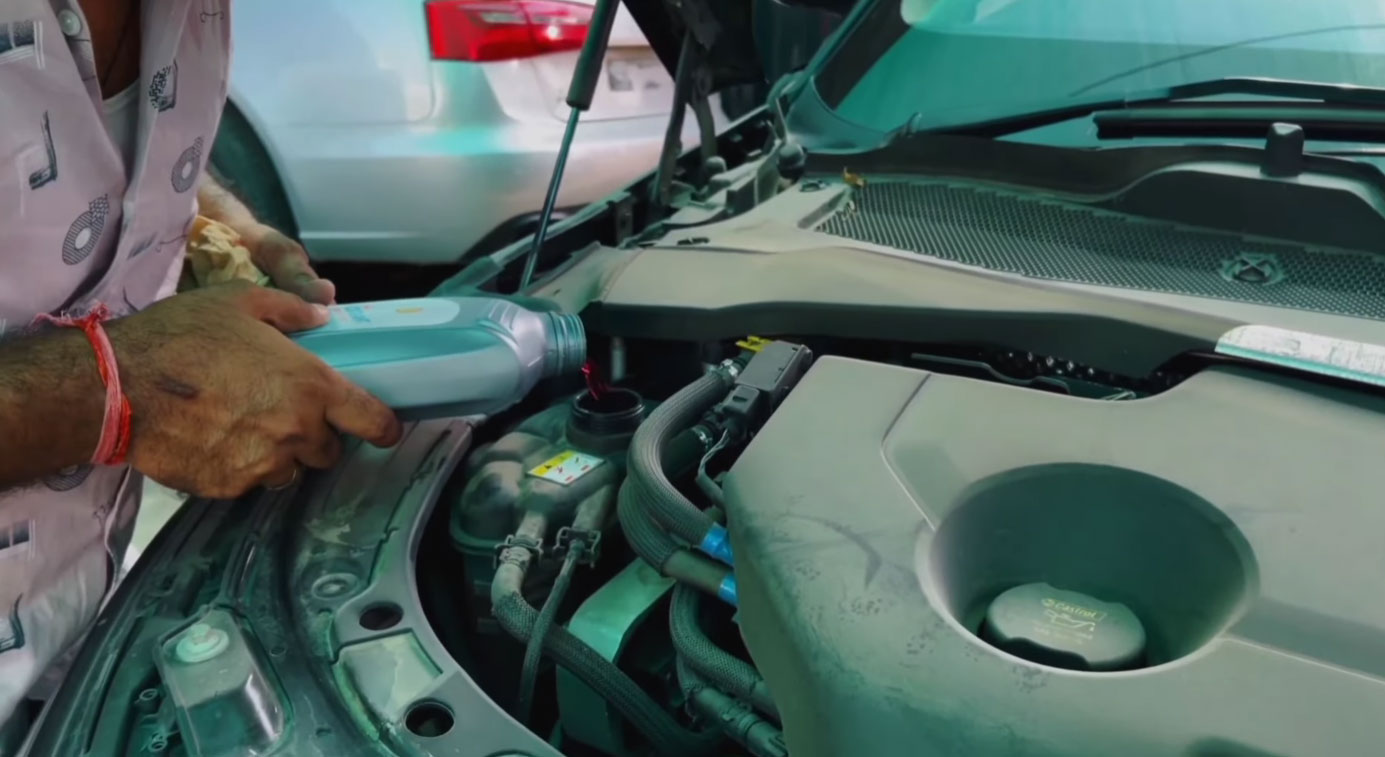
Add Coolant Slowly
Find the expansion tank cap. Twist it off (it usually doesn’t require a wrench—just your hand).
Pour the coolant slowly into the tank. Don’t fill it all the way to the max line yet.
Put the cap back on.
Start the engine and let it run for a minute or two at idle. This lets the coolant circulate through the system. Air pockets sometimes get trapped, and running the engine helps remove them.
Turn the engine off. Wait a few minutes for it to cool slightly.
Remove the cap again and top it up to the “Max” line now. The level may have dropped slightly as the air pockets were expelled.
Put the cap back on securely.
Done. Your coolant level is now correct.
Write It Down
Some owners get low coolant warnings repeatedly because they keep forgetting how often they’re topping up. Write down the date you added coolant.
If you’re adding it more than once a year, you have a leak. Stop ignoring it and get it checked.
Common Mistakes Range Rover Owners Make
In my shop, I see these mistakes again and again:
Mistake 1: Ignoring the Warning for Months
“I’ll get to it eventually.”
That’s how a $500 leak becomes a $3,000 engine problem. Don’t do this. Check it this week.
Mistake 2: Mixing Coolant Types
I’ve seen owners add whatever coolant was on sale at the supermarket. Two weeks later, they’re back with overheating problems and corrosion inside the engine.
Always use the correct type. There’s no substitute.
Mistake 3: Overfilling the Tank
The “Max” line exists for a reason. Overfill the tank and you’re asking for overflow leaks and sensor problems.
Fill to the max line. No higher. That’s it.
Mistake 4: Removing the Radiator Cap When the Engine Is Hot
This is dangerous. You can get third-degree burns from the steam and hot fluid.
Always let the engine cool first. The expansion tank cap is safer, but still cool the engine.
Mistake 5: Thinking the Light Will Go Away on Its Own
It won’t. If it’s a sensor, it’ll keep beeping until you fix it. If it’s a leak, it’ll get worse.
Deal with it now.
FAQ: Coolant Level Questions
Q: Can I drive my Range Rover with the low coolant light on?
A: For a short distance to get it checked? Usually yes, as long as your temperature gauge is normal. For a long highway trip? No. You risk overheating. Get it checked first.
Q: What if my coolant tank is full but the light is still on?
A: The sensor is almost certainly faulty. Your coolant level is fine. The warning is false. You can continue driving, but get the sensor replaced within a month to avoid being caught without a real warning if you ever develop an actual leak.
Q: How much coolant should I add?
A: Add enough to bring the level to the “Max” line on the tank when the engine is cold. Usually this is 0.5 to 2 liters, depending on how low you are. Don’t overfill.
Q: Can I use water instead of coolant in an emergency?
A: Technically, yes, for a very short distance to get to a mechanic. But it won’t protect your engine from corrosion or prevent freeze damage. Use real coolant. It’s only $20.
Q: Why is my coolant level dropping so fast?
A: You have a leak. Water pumps, radiator hoses, and expansion tank cracks are the usual culprits. Have a mechanic inspect it. Don’t keep topping it up and hoping it stops.
Q: Do I need to bleed my cooling system after adding coolant?
A: Not usually. Starting the engine for a minute helps air escape. If you keep getting low coolant warnings after topping up, ask your mechanic to bleed the system to remove air pockets.
Q: Is it normal for my Range Rover to need coolant top-ups between services?
A: No. Sealed systems don’t need top-ups under normal conditions. If you’re doing this, you have a small leak. Don’t ignore it.
Q: What color coolant should my Range Rover have?
A: Pink, orange, or green, depending on the model and year. Check your manual. Never mix colors or types. If you’re unsure what you have, flush and refill with the correct type for your vehicle.
Final Thoughts and Next Steps
A “Low Coolant Level” warning isn’t the worst thing that can happen to your Range Rover. But it’s also not something to ignore and hope disappears.
Here’s your action plan:
Today: Check your coolant level with a cold engine. Look for puddles under the car. Smell for coolant. Write down what you find.
This week: If your level is low, add the correct coolant type to the max line. If you see a leak or suspect one, call a mechanic and get it inspected.
This month: If you’re still getting the warning after topping up, the sensor is likely faulty. Schedule a replacement. It’s a simple fix and cheap peace of mind.
Going forward: Keep an eye on your coolant level during oil changes. If you’re topping up more than once a year, you have a leak. Fix it before it becomes an expensive problem.
Range Rovers are built tough. But they need basic maintenance to stay that way. Coolant isn’t a mystery. It’s just fluid that keeps your engine from cooking itself. Treat it that way and you’ll avoid most of the headaches owners face.
Any questions about your specific situation? A good independent mechanic or your Land Rover dealer can help. But now you’ll know what to tell them—and whether they’re solving the real problem or just throwing parts at it.
Stay safe out there.