
Monday to Saturday - 9:00 am -18:00 pm

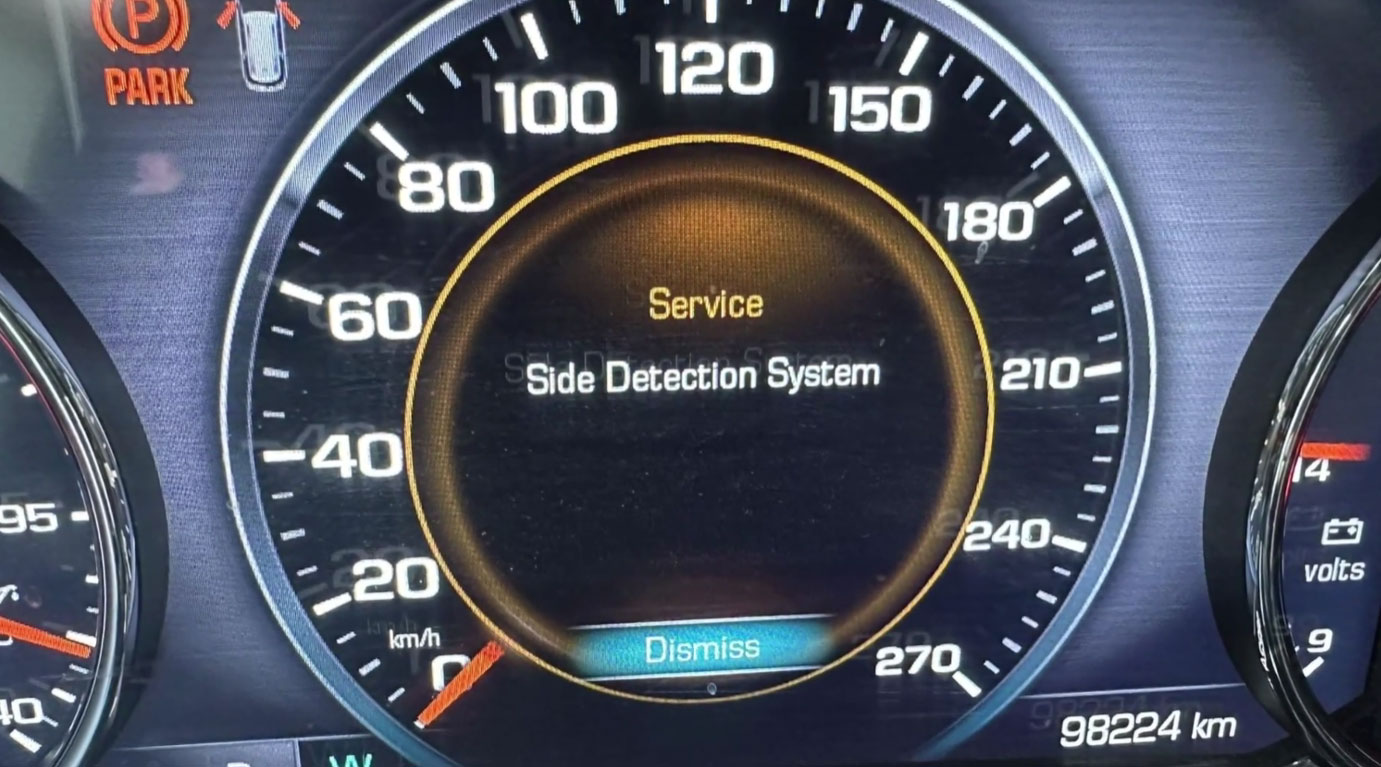
You see the warning on your dashboard. Your side mirror lights stay on. Or worse—they won’t light up at all. You’re wondering if you can still drive the car.
I’ll be honest with you: this is a real problem. I’ve worked on dozens of these systems. Some are minor fixes. Others turn into serious electrical issues that can leave you stranded.
This guide explains exactly what that warning means, why it happens, whether it’s safe to drive, and what it will cost to fix.
What Is the Service Side Detection System?
The service side detection system (sometimes called “side blind zone alert” or “lane change alert”) is your car’s blind spot warning system.
It watches the areas next to and behind your car that you can’t see in your mirrors.
When another vehicle enters one of these invisible zones, the system alerts you with a light in your side mirror or a warning beep.
Some cars also flash your turn signal as a double warning if you try to change lanes into a vehicle it’s detected.
This system is standard on newer GM vehicles (Chevy, GMC, Cadillac, Buick). Other brands use similar technology.
How Does It Work?
The system uses radar sensors mounted in your rear bumper (usually two—one on each side).
Here’s the basic flow:
- Sensors emit waves: The radar sends out millimeter-wave signals that bounce off nearby vehicles.
- Detection zone: The system monitors an area roughly one lane wide, extending about 10 feet behind your car.
- Alert triggers: When a moving vehicle is detected, the system sends a signal to your dashboard and mirror lights.
- You get notified: You see a yellow light if a car is in your blind spot, or a red flashing light if you signal to change lanes into that space.
The system activates automatically when you hit about 10 mph. It only detects moving vehicles—parked cars won’t trigger it.
It’s designed to work together with your driver assistance systems. That’s why some systems tie into your car’s main communication network.
Why Are You Getting This Warning?
A “Service Side Detection System” message means the system has detected a problem with itself.
The warning can mean several things:
The sensor is blocked or dirty. Road salt, mud, snow, or grime can cover the sensors and block the radar signal.
Water got inside the module. This is the most common issue. The sensor modules are mounted in the rear bumper area. Water from rain, car washes, or snow can seep into connectors and cause corrosion.
The module is failing. The electronic control module inside can fail due to corrosion or a manufacturing defect.
Wiring is damaged or loose. A corroded connector, broken wire, or loose harness can prevent the system from communicating.
The system has temporarily lost signal. Sometimes the warning clears itself after a few minutes if the sensor dries out or the connection stabilizes.
Is It Safe to Drive?
Here’s the question everyone asks: Can I keep driving with this warning on?
Short answer: Your car will still run and move. But there’s a catch.
The blind spot system itself is not critical to engine operation. You don’t need it to start your car or drive down the road. Plenty of older cars never had these systems.
However, the warning can mask bigger problems.
This is where I need to be straight with you.
In many GM vehicles, the side detection module is connected to your car’s main communication network (the CAN bus). When the module fails, it can corrupt the data flowing through that network.
I’ve seen cars where a failed side detection module caused:
- Dashboard gauges going black
- Radio shutting off
- Backup camera failing
- Turn signals malfunctioning
- Doors randomly locking and unlocking
- The car refusing to start
One customer told me his headlights shut off while driving 50 mph because the sensor module failure cascaded into other systems.
So the bottom line:
- If it’s just a sensor that needs cleaning, you’re fine to drive.
- If it’s a module failure, I recommend getting it fixed soon. Don’t ignore it for weeks.
- If you’re seeing other electrical warnings pop up (cluster going dark, radio failing, windows not working), stop driving and get it to a shop. This is a sign the failure is spreading.
Common Causes and How to Fix Them
Cause 1: Dirty or Blocked Sensor
What happens: Road salt, snow, or mud builds up on the sensor lens. The radar signal gets blocked.
How to fix it:
- Wash your car, paying special attention to the rear bumper area where sensors are mounted.
- Use a soft cloth to gently clean the sensor area.
- Cost: Free (or the cost of a car wash).
Does it work? Sometimes. If the warning clears after washing, the sensor was just dirty. But if the warning comes back after a few miles, it’s likely something deeper.
Cause 2: Water Inside the Module (Water Intrusion)
What happens: Water seeps into the connector or the module housing. Corrosion builds up. The module stops communicating.
This is the most common problem I see.
Where does water come from?
- Heavy rain
- Driving through puddles
- Car wash spray hitting the bumper underside
- Snow melt pooling near the sensor
- Road salt and moisture sitting in that area all winter
Why is this a design flaw?
The sensors are mounted right there on the rear bumper, exposed to the elements. They’re not sealed like some other components. In salt-belt areas (rust belt states), this is a major issue.
GM knows about this. They issued technical service bulletins and even extended coverage for some model years.
How to fix it:
- Have a dealer replace the module and harness with updated parts
- Cost: $800–$2,200 depending on your model
Can you prevent it?
- Keep the underside of your bumper clean
- Try to avoid driving through deep puddles if you know the sensor area will get soaked
- After winter, flush the area with fresh water to rinse away salt
- Some people apply protective coatings like Fluid Film to the area
Cause 3: Faulty Wiring or Connector
What happens: The connector corrodes. A wire breaks. The signal can’t reach the module.
How to fix it:
- Inspect the wiring harness for visible damage or corrosion
- Have the connector cleaned or replaced
- Replace the wiring harness if damaged
Cost: $400–$800 for harness replacement, depending on labor.
Cause 4: Failed Module
What happens: The electronic module itself fails. It could be a manufacturing defect or corrosion inside.
How to fix it:
- Replace the module with a new one (or updated part)
- Some modules need to be programmed by the dealer
Cost: $400–$600 for parts, plus labor. Total: $800–$1,400.
What Will This Cost to Fix?
Repair costs vary widely. Here’s what I typically see:
| Issue | Parts | Labor | Total |
|---|---|---|---|
| Dirty sensor (cleaning) | $0 | Free | Free |
| Failed module (one side) | $200–$400 | $200–$400 | $400–$800 |
| Harness replacement | $150–$300 | $200–$400 | $350–$700 |
| Both modules + harness | $400–$600 | $300–$600 | $700–$1,200 |
| Dealer repair | $200–$600 | $300–$700 | $800–$2,200 |
Warranty coverage:
- Within bumper-to-bumper warranty (3 years/36,000 miles): Usually covered at no cost.
- Special coverage from GM: Some 2013–2017 models have extended coverage for water intrusion up to 6 years/100,000 miles.
- Out of warranty: You pay the full cost.
Tip: Check if you qualify for GM’s special coverage. Call your dealer with your VIN and mileage. You might be covered even if you’re past the original warranty.
Common Mistakes Drivers Make
Mistake 1: Ignoring the warning for months
Many people see the warning and think, “I’ll deal with it later.”
Problem: A small sensor issue can become a major electrical nightmare. I’ve seen warning progress from “side detection unavailable” to “whole electrical system fails” in just a few weeks.
What to do: Get it diagnosed within 1–2 weeks. It’s usually a quick scan.
Mistake 2: Going to the cheapest shop without diagnosis
A shop charges $150 to scan your car. Another wants $900 to replace the module. You pick the cheap one.
Problem: They might replace the wrong part. You could end up paying twice and still have the problem.
What to do: Get a proper diagnostic first. Ask which module is failing, or if it’s the wiring. Then get multiple quotes for that specific fix.
Mistake 3: Assuming your car is unsafe
The warning says “service” the system. Some drivers think their car is unsafe to drive and park it.
Truth: The system itself isn’t safety-critical. You can drive without it. But don’t let the warning progress to bigger electrical issues. Get it fixed soon.
Mistake 4: Paying dealership labor rates without comparing
Dealerships often charge $100–$200/hour for labor. Independent shops might charge $50–$100/hour for the same work.
The diagnostic code and repair are identical either way.
What to do: Get quotes from 2–3 shops. The part price won’t change, but labor rates will.
Mistake 5: Trying to disconnect the module yourself
I’ve had customers ask if they can just pull a fuse or unplug the sensor to make the warning go away.
Problem: The module is part of your car’s main communication network. Disconnecting it can cause other systems to fail (cluster, radio, windows, locks).
Better option: Have a shop disconnect it properly, or just get it fixed.
Real-World Example
A customer drove in with a 2015 Chevy Impala. The dashboard showed “Service Side Detection System.”
The mirror lights stayed on constantly, draining the battery.
The customer asked, “Can I just live with it?”
I scanned the vehicle. The passenger-side module was failing. Water had gotten inside the connector.
Cost to fix: $850 (module + labor).
I explained: “Right now, it’s just draining your battery. But if this module goes completely bad, it could corrupt the communication system. Then your cluster, radio, and doors might malfunction.”
He had it repaired two days later. Good call.
Six months later, he came back for an oil change. He said another shop had told him the same module would fail again because of the design. I offered to apply a protective coating to the area. He agreed, and so far, so good.
FAQ: Your Questions Answered
Q: Can I drive my car with this warning?
A: Yes, short distances. But don’t ignore it for weeks. Get it diagnosed soon. If you notice other electrical issues starting to happen (radio cutting out, cluster glitching), stop driving and have it towed.
Q: Will the warning go away on its own?
A: Sometimes, temporarily. If the sensor was just wet or cold, it might clear after the car warms up or dries. But if it comes back repeatedly, the module is failing and needs repair.
Q: Is this a recall?
A: Not for all vehicles. GM issued special coverage for water intrusion on some 2013–2017 models (Cruze, Impala, Acadia, Terrain). Check your vehicle. It might be covered free.
Q: What if I just disconnect the sensor?
A: You’ll lose the warning light and the system, but other electrical systems might malfunction because it’s connected to the car’s main network. Not recommended. Get it fixed properly instead.
Q: Does this happen on all brands or just GM?
A: Mostly GM vehicles (Chevy, GMC, Buick, Cadillac). Some BMW and Mercedes models have had similar issues. It’s a design problem with how these sensors are mounted and sealed.
Q: How often does this fail?
A: It’s very common on 2013–2017 GM vehicles. Less common on 2018+, but still happens. If you live in a rust-belt area with snow and salt, the odds increase.
Q: Can I prevent this?
A: Partially. Keep the rear bumper area clean. Rinse with fresh water after winter to remove salt. Some people apply protective coatings. But if you live in a harsh climate and the module is old, it will eventually fail.
Q: What if the warning comes back after repair?
A: That’s frustrating but not uncommon. It means either the wrong part was replaced, or there’s a deeper electrical issue (wiring, connector). Have them re-scan and check the wiring. If the same module fails again within the warranty period (1 year), they should replace it for free.
Q: Should I buy a car with this warning?
A: Ask the seller if it’s been diagnosed and repaired. If not, factor in the $800–$1,200 repair cost when negotiating. If it was recently repaired, it should be fine. If the seller says, “It goes away sometimes,” walk away. That’s a sign of a chronic issue.
The Bottom Line
The service side detection system is a helpful safety feature that warns you about blind spots.
When it fails, it’s usually because water got into the module. It’s not safe to ignore for months, but it’s also not an emergency like a brake failure.
Here’s what to do:
- Get it scanned to identify the exact problem.
- If it’s just a dirty sensor, clean it and see if the warning goes away.
- If it’s a failed module, plan to repair it within 1–2 weeks.
- Shop around for labor rates (dealership vs. independent shop).
- Check if you qualify for GM’s special coverage (might be free).
- If you see other electrical problems starting, stop driving and get it towed.
Most repairs run $800–$1,200. It’s annoying and expensive, but it’s fixable.
And if you’re buying a used car with this warning? Factor in the repair cost. You’ll need to budget for it.
Need a diagnostic? Find a trusted shop near you. Get a proper scan before any repair. It’s usually $60–$100 and worth every penny to know exactly what you’re dealing with.
whoah this weblog is excellent i like reading your posts.
Keep up the good work! You recognize, a lot of people are searching round for this info,
you can help them greatly.